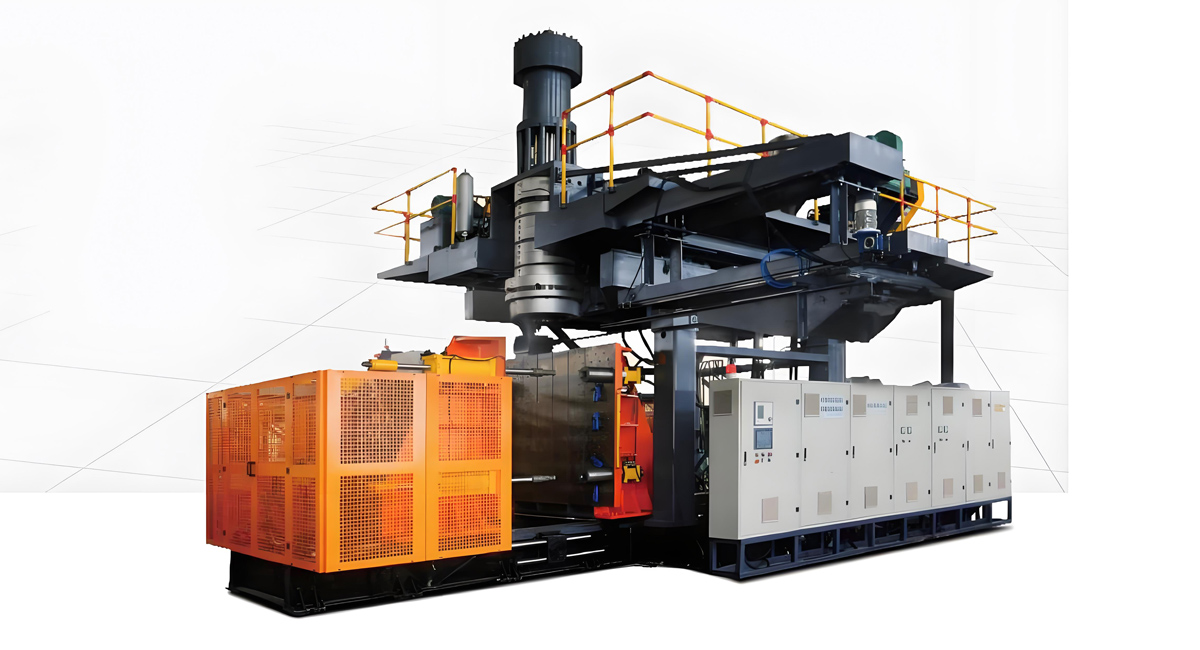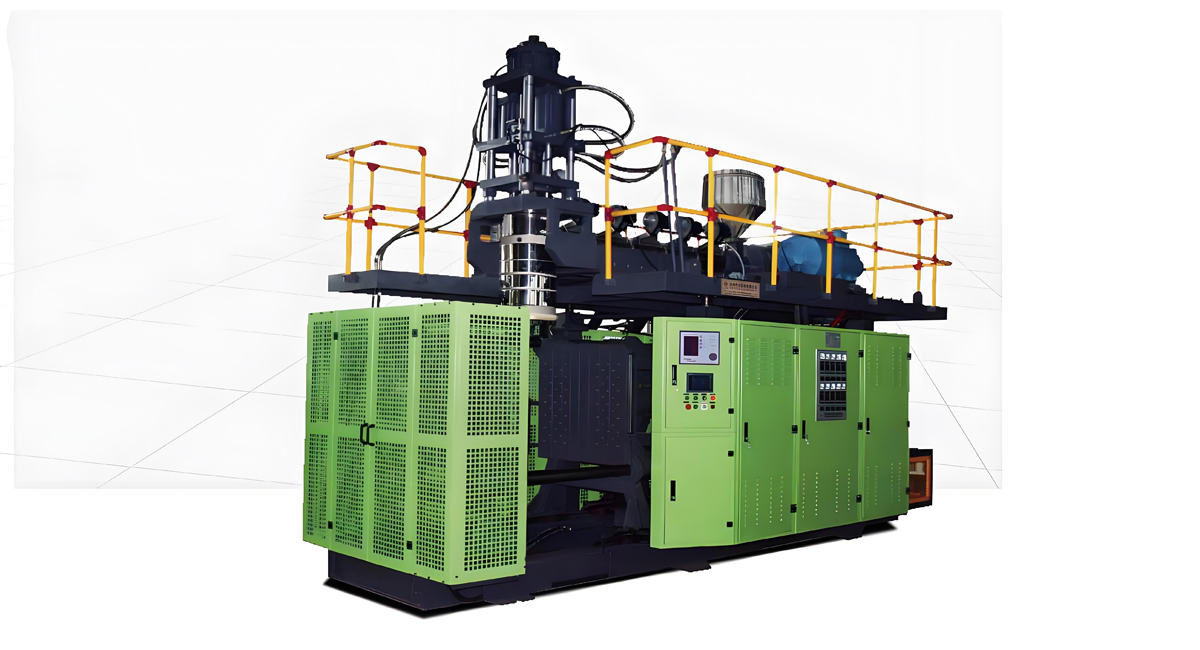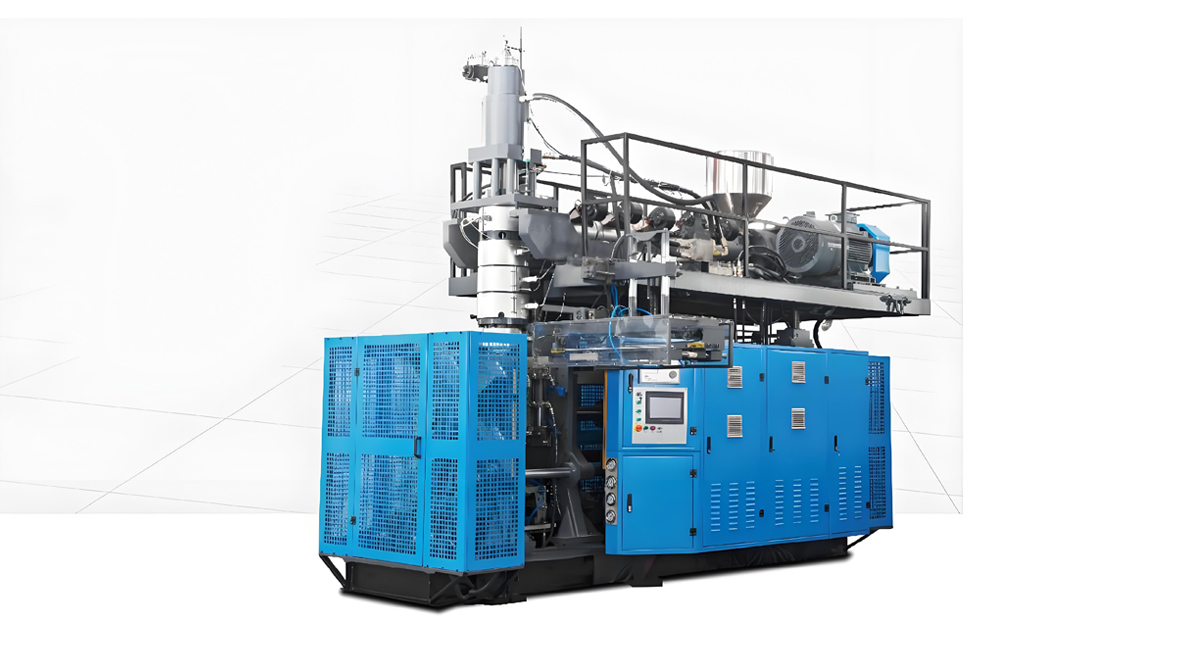

As core equipment for the molding of hollow plastic products, single-station and double-station extrusion blow molding machines exhibit significant differences in production efficiency, application scenarios, cost investment, and other aspects due to structural design variations. This article conducts a comprehensive and detailed comparison from dimensions such as structural principles, production performance, application scope, cost-effectiveness, and operation & maintenance, combined with specific parameters and cases, to provide a reference for enterprises in equipment selection.
I. Core Differences in Structural Principles
1. Single-Station Extrusion Blow Molding Machine
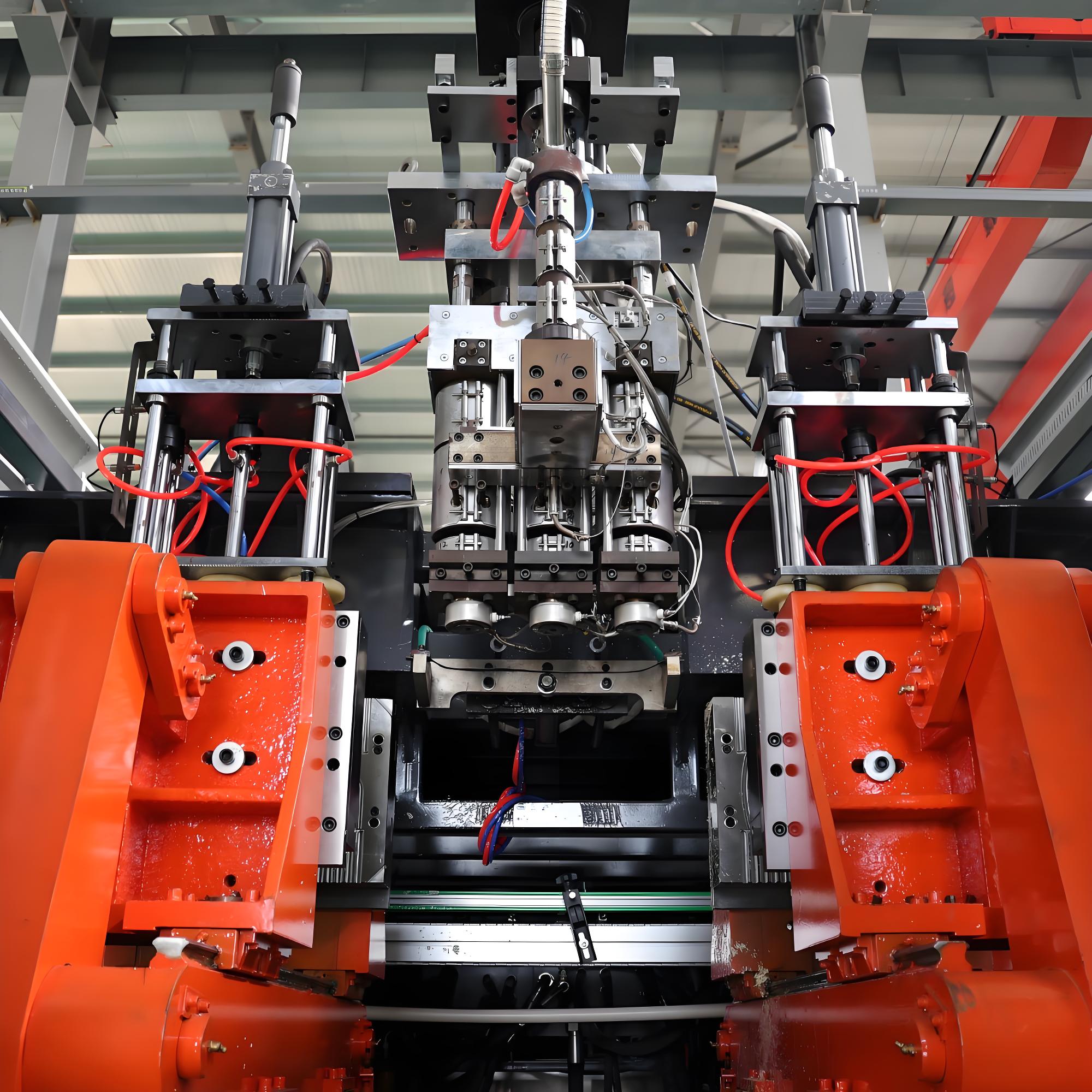
The core structure of a single-station machine consists of “one extrusion system + one set of blow molding molds + one set of mold clamping and air blowing mechanisms”, with only one independent working area in the entire machine. During operation, it follows a continuous single-cycle process of “parison extrusion → mold clamping → blow molding → cooling → demolding”. Each process is completed sequentially, and the next cycle can only start after the previous one ends. When the mold is in the cooling and demolding stage, the extrusion system needs to pause or wait, resulting in periodic idleness of the equipment. Its structure is relatively compact, mainly composed of a feed hopper, extrusion barrel, single die head, single set of templates, mold clamping cylinder, and simple control system. The mechanical transmission path is short, and the mold positioning accuracy depends on the stability of the single set of mechanisms.
2. Double-Station Extrusion Blow Molding Machine
The double-station machine adopts a design of “one extrusion system + two sets of blow molding molds + two sets of mold clamping and air blowing mechanisms”, realizing alternating operation of the two stations through cross guide rods and left-right moving cylinders (some models are arranged vertically). The core logic is “station complementarity”: when station A completes parison extrusion and mold clamping and enters the cooling and demolding stage, station B moves to the position below the extrusion head synchronously to start the processes of parison extrusion, mold clamping, and blow molding. The two stations circulate alternately, enabling the extrusion system to work continuously without obvious idle time. Its structure adds a double-station translation mechanism (mostly high-precision linear guideways), a synchronous transmission system, and an upgraded PLC control system, which can accurately control the action coordination of the two stations to ensure production continuity.
It should be supplemented that some high-end models support single/double-station switching (such as dual-purpose models in patented technologies). They drive one station to work and the other to stop through cylinders, balancing flexibility and versatility, but their structural complexity is higher than that of pure single/double-station models.
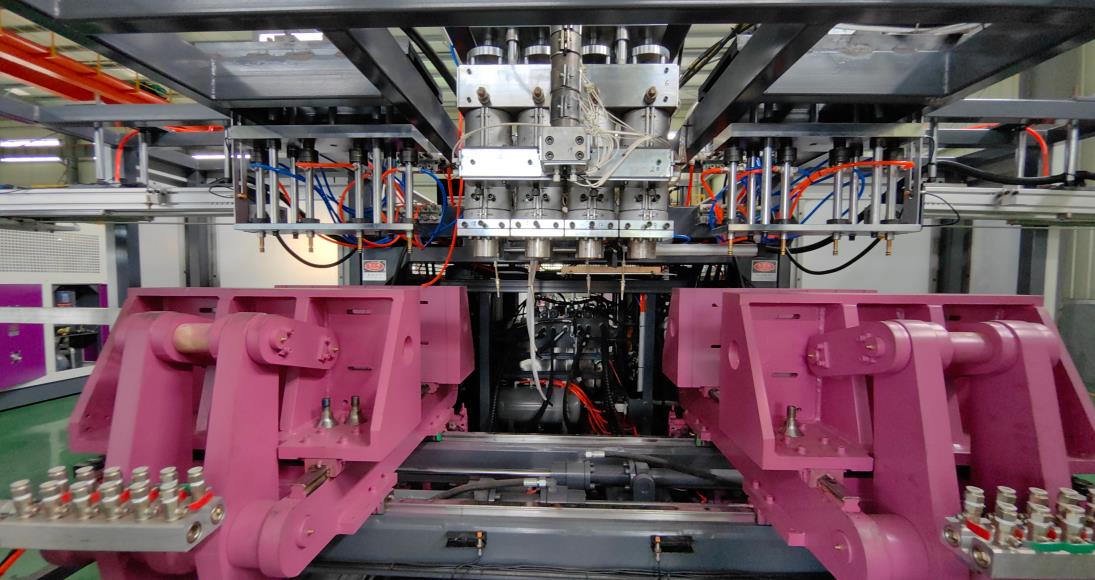
II. Comparison of Production Efficiency
Production efficiency is the core difference between the two, mainly reflected in three aspects: cycle time, unit output, and equipment utilization rate.
1. Cycle Time
The cycle time of a single-station machine is the sum of “extrusion time + mold clamping time + blow molding time + cooling time + demolding time”. The equipment is in a waiting state during the cooling and demolding stage, which usually accounts for 40%-60% of the cycle. Taking a 1L plastic bottle as an example, the cycle time of a single-station machine is about 12-18 seconds.
The double-station machine shortens the cycle through process superposition, where the cooling and demolding time overlaps with the extrusion and mold clamping time of the other station. The overall cycle time is approximately equal to the “extrusion + mold clamping + blow molding” time of the single-station machine, with only an additional 1-2 seconds of station switching time compared to a single process of the single-station machine. For the same specification of 1L plastic bottle, the cycle time of the double-station machine can be shortened to 8-10 seconds.
2. Unit Output
Theoretically, the output of the double-station machine is 60%-70% higher than that of the single-station machine, and can be nearly doubled in some scenarios (small-sized products, long cooling time). Third-party data shows that under the same die head configuration, the output of the double-station machine is 1.3-1.5 times that of the single-station machine. For example, to produce 30,000 1L bottles:
- Single-station (electric model): Production time 58 hours + preparation time 1 hour, total 59 hours;
- Traditional hydraulic double-station: Production time 50 hours + preparation time 8 hours, total 58 hours.
It should be noted that for small-batch production, the long preparation time of the double-station machine (about 8 hours for mold debugging and parameter calibration) will offset the output advantage, and the single-station machine (preparation time 1 hour) has higher efficiency flexibility at this time.
3. Equipment Utilization Rate
The utilization rate of the extrusion system of the single-station machine is about 40%-60%, which is completely idle during the cooling stage; the utilization rate of the extrusion system of the double-station machine can reach more than 90%, with only a short low-load state at the moment of station switching, and the equipment capacity is fully released.
III. Application Scenarios and Product Adaptability
The differences in application scenarios between the two stem from the adaptability of their structures to product specifications, production batches, and process requirements, with specific correspondences as follows:
| Comparison Dimension | Single-Station Extrusion Blow Molding Machine | Double-Station Extrusion Blow Molding Machine |
| Product Specifications | More suitable for large-scale products (volume above 10L, such as chemical drums, large storage tanks). The mold size is not limited by the translation space of the double station, and the molding stability is stronger. | Focus on small and medium-sized products (5ML-10L, such as beverage bottles, food cans, small chemical bottles). The translation space of the double station limits large molds. |
| Production Batch | Small-batch and multi-variety production. Mold replacement and parameter debugging are fast, without bearing the high preparation cost of the double-station machine. | Mass and single-variety production. High output can amortize the initial investment in equipment and molds, reducing the unit product cost. |
| Product Complexity | Suitable for products with complex shapes and uneven wall thickness (such as special-shaped chemical containers). The single-station machine focuses on single-cycle operation, with more precise parameter adjustment and lower scrap rate. | Suitable for products with regular shapes and uniform wall thickness (such as standard bottles and cans). The coordinated operation of the double-station machine has higher requirements for parameter consistency, and complex products are prone to precision deviations. |
| Industry Adaptation | Small chemical, building materials, and customized packaging enterprises with flexible needs and limited batches. | Food and beverage, pharmaceutical packaging, and large-scale daily chemical enterprises with high requirements for output and standardization. |
In terms of material adaptability, both can handle common plastic raw materials such as PE, PP, and PA without significant differences. The core difference lies in the limitation of product specifications on the equipment structure.
IV. Comparison of Cost-Effectiveness
1. Initial Investment Cost
Single-station: Low equipment purchase cost (about 50%-70% of the same-specification double-station machine), only one set of molds is needed, the mold investment is 50% less than that of the double-station machine, and it covers a small area (saving 30%-40% of space compared to the double-station machine), suitable for enterprises with limited budgets and tight workshop space.
Double-station: High equipment purchase cost, requiring two sets of molds, and the initial investment is 1.5-2 times that of the single-station machine; in addition, due to the complex structure, supporting components such as PLC control system and high-precision guideways further increase the cost, and it has higher requirements for workshop space.
2. Operating Cost
- Energy consumption: The energy consumption of the single-station machine (electric model) is 30% lower than that of the hydraulic double-station machine. The double-station machine has higher motor load and heating energy consumption due to the coordinated operation of dual mechanisms;
- Labor: The double-station machine has a higher degree of automation (some support full-automatic counting and packaging), which can save 50% of labor costs; the single-station machine mostly requires manual assistance for demolding and counting, resulting in higher labor costs;
- Maintenance: The single-station machine has a simple structure, few fault points, and low maintenance costs. Screw disassembly and wear detection do not require professional equipment; the double-station machine needs to maintain two sets of mold clamping mechanisms and synchronous transmission systems, with high maintenance difficulty. Modular disassembly requires professional operators, and the annual maintenance cost is about 1.2-1.5 times that of the single-station machine.
3. Unit Product Cost
Single-station: For small-batch production, the unit cost is low (no high preparation cost amortization); for mass production, the unit amortization cost of labor and energy consumption is high due to low efficiency.
Double-station: For mass production, high output amortizes initial investment and operating costs, and the unit product cost is 15%-25% lower than that of the single-station machine; for small-batch production, high preparation costs and idle energy consumption will push up the unit cost.
V. Quality Control and Operation & Maintenance
1. Quality Control Precision
Single-station: Independent single-cycle operation, more precise adjustment of parameters such as temperature, blow molding pressure, and cooling time, strong stability of product dimensional accuracy and wall thickness uniformity, suitable for customized products with high quality requirements.
Double-station: Relies on parameter consistency between the two stations. If there is a deviation in the synchronous mechanism, it is easy to cause uneven product quality between the two stations; however, high-end double-station machines are equipped with precise temperature control systems and air storage tanks, which can ensure stable air source, and the product consistency is better than that of ordinary single-station machines.
2. Operation and Maintenance Difficulty
Single-station: Simple operation, intuitive parameter debugging, no professional skills required for operators; convenient maintenance, easy fault diagnosis, and daily inspection only needs to check the mold clamping cylinder and extrusion system, suitable for enterprises with limited technical reserves.
Double-station: Requires operators to master the coordinated parameter adjustment of the two stations and be familiar with the fault alarm and diagnosis functions of the PLC system; complex maintenance, requiring regular calibration of the precision of synchronous gears and linear guideways, and synchronous adjustment of the positioning of the two stations when replacing molds, with high technical requirements.
VI. Selection Suggestions
1. Priority to single-station: Enterprises engaged in small-batch and multi-variety production, with limited budgets and small workshop space, or those needing to produce large-scale and complex products above 10L;
2. Priority to double-station: Enterprises engaged in mass and single-variety production, pursuing high output and standardization, or industries such as food and beverage, and pharmaceuticals with high requirements for automation and hygiene standards;
3. Dual-purpose single/double-station machines for flexible needs: They can meet both small-batch customization and large-scale production, reducing repeated investment, but the initial cost is higher than that of pure single-station machines.
VII. Summary
The core difference between single-station and double-station extrusion blow molding machines lies in the operation logic of “single cycle” and “double alternation”: the single-station machine adapts to niche needs with “low cost and high flexibility”, while the double-station machine empowers large-scale production with “high output and high automation”. Enterprises should comprehensively judge the selection based on product specifications, production batches, cost budgets, and industry needs, rather than simply pursuing efficiency or cost advantages, to achieve the optimal matching of production capacity and benefits.