I. Classification and Core Characteristics of Hollow Plastic Products
Hollow plastic products are articles with closed cavity structures formed by blow molding processes, widely used in packaging, industry, automotive and other fields. They are divided into four categories according to application and structure:
| Product Category | Typical Products | Core Structural and Performance Requirements | Main Raw Materials |
|---|---|---|---|
| Packaging Hollow Products | Beverage bottles, chemical drums, food cans | Good sealing, chemical corrosion resistance (for chemical packaging), compliance with food-grade standards | HDPE (High-Density Polyethylene), PET (Polyethylene Terephthalate), PP (Polypropylene) |
| Industrial Container Category | Large storage tanks, transport tanks, tool boxes | High strength, impact resistance, aging resistance, dimensional stability | HDPE, LLDPE (Linear Low-Density Polyethylene), PVC (Polyvinyl Chloride) |
| Automotive/Transport Category | Fuel tanks, air conditioning ducts, bumper cores | Oil/temperature resistance (for fuel tanks), lightweight, structural strength | HDPE (for fuel tanks), PP (for air ducts) |
| Daily Sundry Category | Plastic chairs, toys, fitness equipment parts | Good toughness, attractive appearance, low cost | PP, LDPE (Low-Density Polyethylene), ABS (Acrylonitrile Butadiene Styrene) |
II. Core Points of Production Process for Hollow Plastic Products
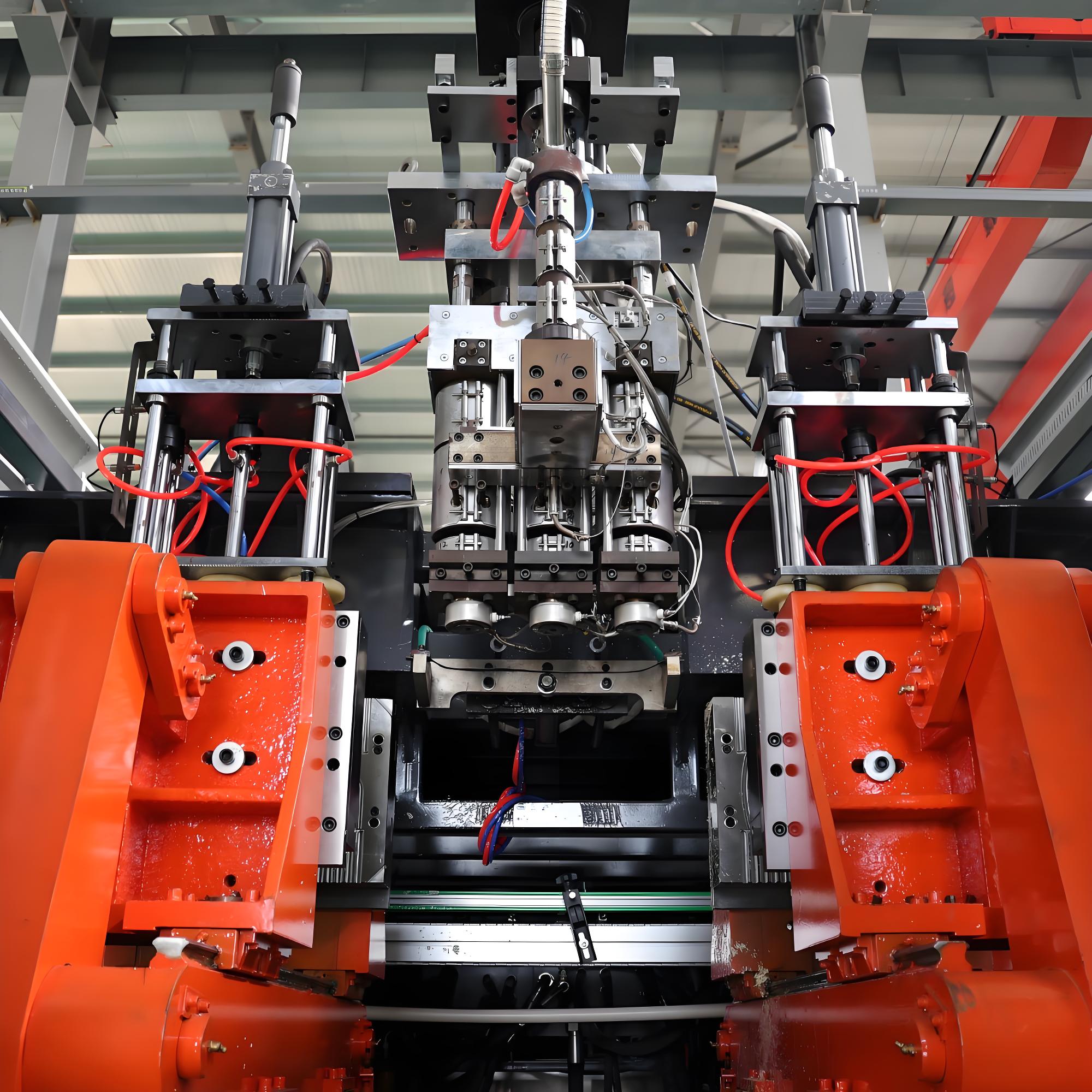
Extrusion blow molding is the mainstream forming process for hollow products, with its core lying in the precise control of “parison forming – inflation fitting – cooling and setting”. The process differences for different products are mainly reflected in the following dimensions:
1. Raw Material Selection and Pretreatment
- Packaging products: Food-grade HDPE must comply with FDA/GB 4806 standards; chemical drums should use acid and alkali-resistant high-density polyethylene (density ≥0.94g/cm³), and pretreatment requires drying (moisture content ≤0.02%);
- Industrial containers: Large storage tanks prefer high melt flow index HDPE (MI=0.3-1.0g/10min) to ensure parison fluidity;
- Automotive parts: Fuel tanks need barrier HDPE (added with EVOH barrier layer), and air conditioning ducts require anti-aging PP (added with UV stabilizers).
2. Parison Quality Control
The parison is the foundation for forming hollow products, and its wall thickness uniformity directly determines product quality:
- Small products (e.g., beverage bottles): Parison wall thickness deviation ≤±5%, equipped with electric die lips or axial wall thickness control system;
- Large products (e.g., 1000L storage tanks): Adopt accumulator-type parison forming to avoid parison sagging caused by continuous extrusion; the accumulator volume should match the product weight (accumulator volume = product weight × 1.2~1.5);
- Multi-layer products (e.g., barrier fuel tanks): Use multi-layer co-extrusion die heads, with synchronous extrusion speed of materials in each layer (deviation ≤±2%).
3. Inflation and Cooling Setting
- Blow-up ratio: 1.5~3:1 for small packaging products, 1.2~2:1 for large industrial containers; inflation pressure 0.3~0.8MPa (adjusted according to product size);
- Cooling time: 5~15s for small products, 30~120s for large products; molds need multi-stage cooling channels (temperature difference ≤±3℃);
- Demolding timing: Demold when the product is cooled below the heat distortion temperature (about 80℃ for HDPE, about 100℃ for PP) to avoid deformation.
III. Core Dimensions for Selection of Extrusion Blow Molding Machines
The selection of extrusion blow molding machines must match product type, production capacity requirements and quality standards, with core decisions made from three aspects: “machine type – parameter matching – configuration selection”.
1. Machine Type Selection (by Forming Method)
| Machine Type | Core Characteristics | Applicable Product Range | Production Capacity |
|---|---|---|---|
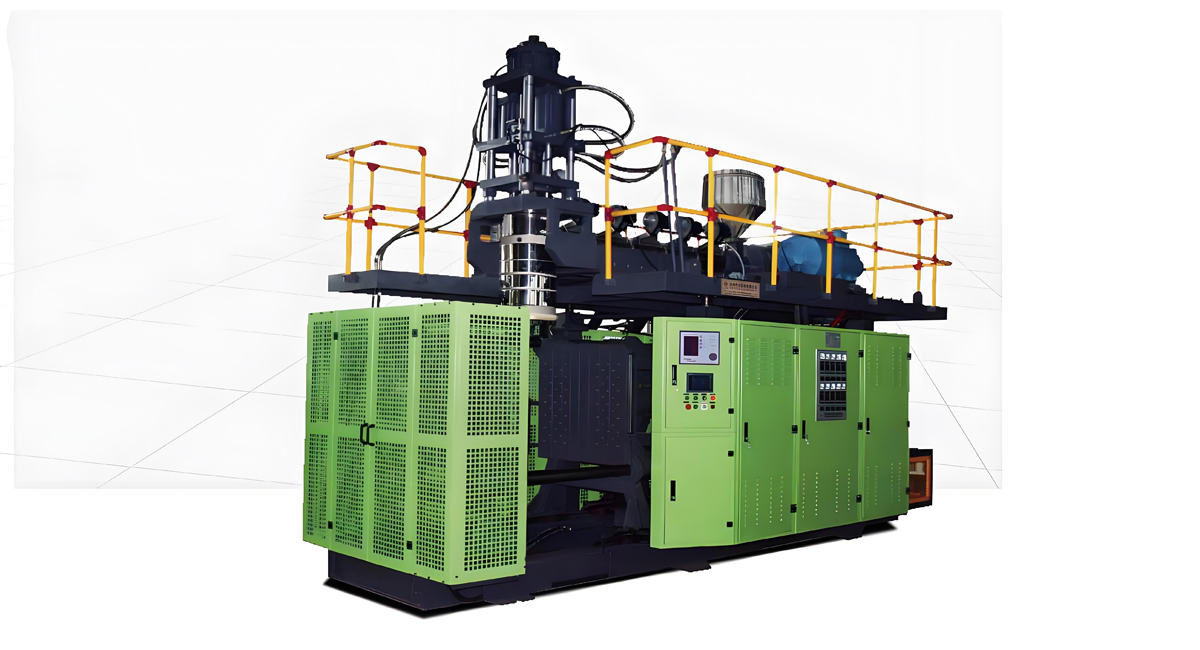
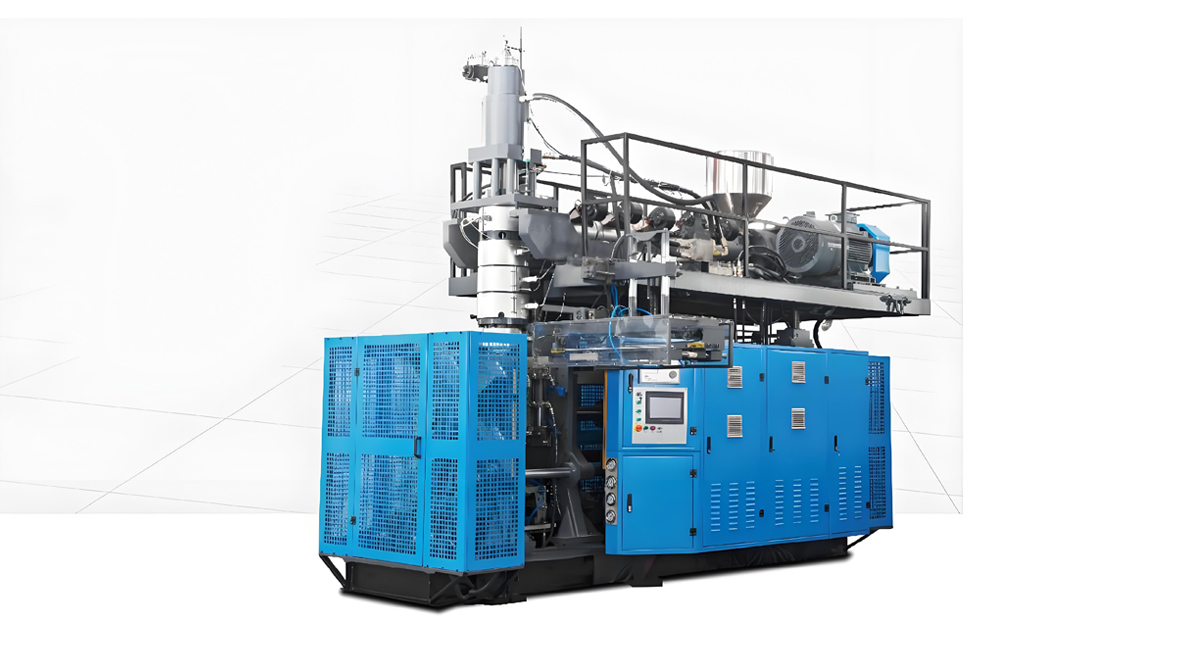
| Continuous Extrusion Blow Molding Machine | Continuous parison extrusion, high efficiency, simple structure | Small/medium hollow products (≤200L), such as beverage bottles, chemical drums | 500~5000 pieces/day (single station) |
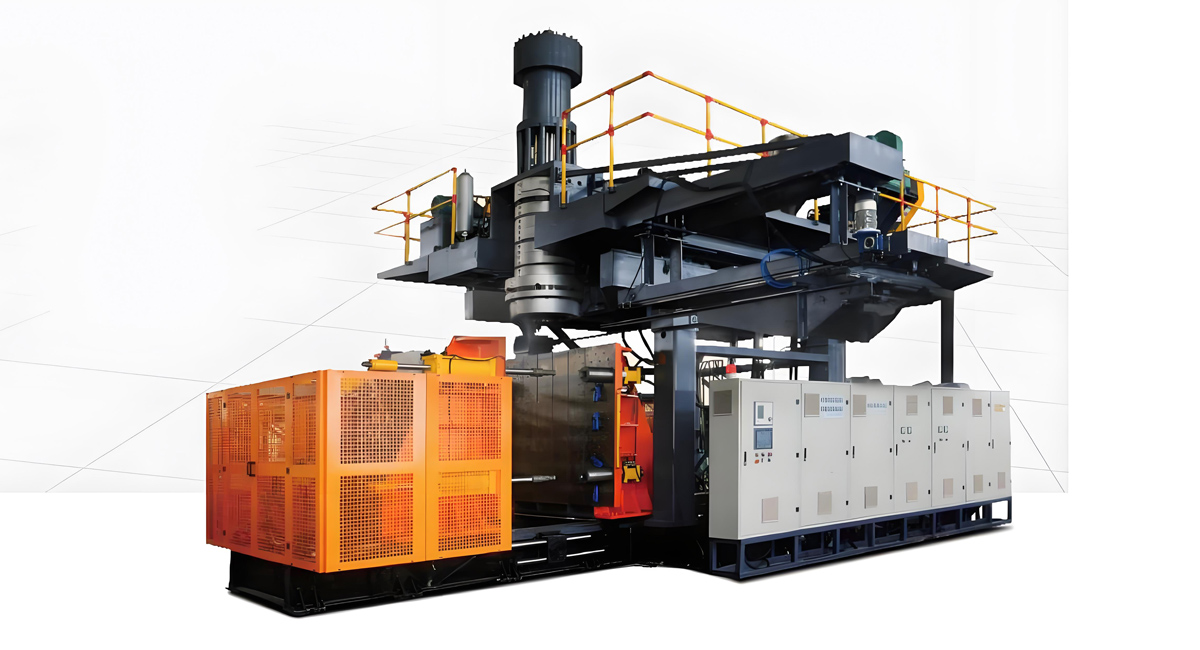
| Accumulator-type Blow Molding Machine | Melt stored in accumulator, single extrusion of large parisons | Large hollow products (≥200L), such as storage tanks, transport tanks | 10~50 pieces/day (single station) |
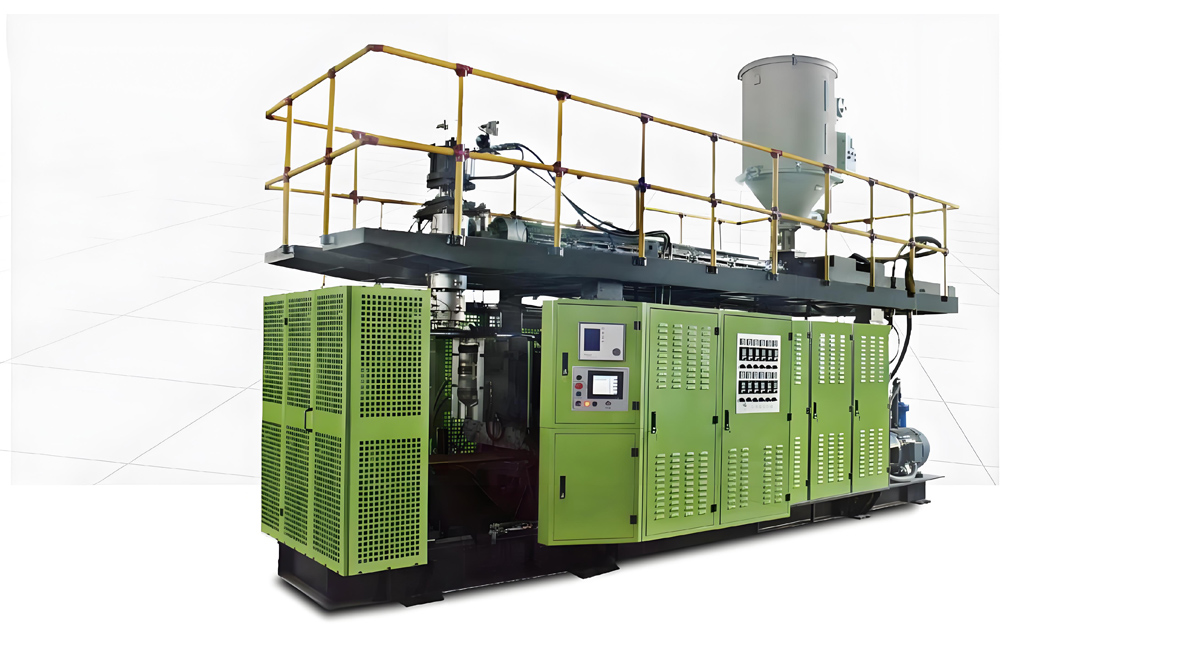
| Multi-layer Co-extrusion Blow Molding Machine | Multiple extrusion systems, forming multi-layer composite products | Barrier products (fuel tanks, high-barrier packaging drums) | 300~2000 pieces/day (single station) |
| Injection Stretch Blow Molding Integrated Machine | Injection preform + stretching + inflation, high precision | High-precision small hollow products (e.g., PET beverage bottles) | 1000~10000 pieces/day |
2. Key Parameter Matching
(1) Extrusion System Parameters
- Screw diameter: Selected according to product weight (reference formula: screw diameter D(mm)≈√(product weight(g)/10)):
- Small products (≤1kg): D=30~50mm;
- Medium products (1~10kg): D=50~90mm;
- Large products (≥10kg): D=90~150mm;
- Length-diameter ratio (L/D): 20~25:1 for polyolefin raw materials, 18~20:1 for heat-sensitive raw materials such as PVC;
- Extrusion capacity: Must match production capacity requirements (extrusion capacity = product weight × daily output ÷ production time ÷ yield rate).
(2) Clamping System Parameters
- Clamping force: Calculated according to product projected area (clamping force(kN)=maximum product projected area(cm²)×0.3~0.5) to avoid mold opening during inflation;
- Template stroke: ≥1.5×maximum product height to ensure demolding space;
- Mold installation size: Match mold length and width, reserving positions for cooling water channels and pneumatic interfaces.
3. Brand and Configuration Selection
- Entry-level needs (small batch, low cost): Domestic economical machines (e.g., brands from Zhangjiagang, Ningbo), standard-equipped with PLC control and manual wall thickness adjustment, suitable for small daily products;
- Mid-end needs (large-scale production): Domestic mid-end brands (e.g., Jinwei, Tongda), equipped with automatic wall thickness control system and servo clamping, suitable for chemical drums and automotive air ducts;
- High-end needs (high precision, high barrier products): Imported brands (e.g., Kautex from Germany, Battenfeld from Austria) or domestic high-end machines, equipped with multi-layer co-extrusion die heads and online quality inspection systems, suitable for fuel tanks and high-barrier packaging.
IV. Matching Cases of Production and Blow Molding Machines for Typical Hollow Products
Case 1: Production of 20L HDPE Chemical Drums
- Product requirements: Uniform wall thickness (≥1.5mm), drop resistance (no damage after 1.8m drop), compliance with food/chemical grade standards;
- Recommended blow molding machine: Continuous extrusion blow molding machine (screw diameter 65mm, L/D=24:1), equipped with axial wall thickness control system;
- Process parameters: Extrusion temperature 180~200℃, blow-up ratio 2:1, inflation pressure 0.5MPa, cooling time 20s;
- Production capacity: 800 pieces/day for single station, yield rate ≥98%.
Case 2: Production of 1000L HDPE Large Storage Tanks
- Product requirements: Integral molding without welds, impact resistance (no cracking in drop hammer impact at -20℃), service life ≥10 years;
- Recommended blow molding machine: Accumulator-type blow molding machine (accumulator capacity 50kg, screw diameter 120mm), with dual die heads for alternate forming;
- Process parameters: Accumulator pressure 15~18MPa, parison extrusion speed 50mm/s, blow-up ratio 1.5:1, cooling time 90s;
- Production capacity: 15 pieces/day for single station, yield rate ≥95%.
Case 3: Production of Automotive HDPE Fuel Tanks
- Product requirements: Multi-layer barrier (HDPE+EVOH), oil permeability resistance (permeability ≤2g/m²·day), lightweight;
- Recommended blow molding machine: Five-layer co-extrusion accumulator-type blow molding machine (screw diameters 90mm/65mm/45mm/65mm/90mm respectively), equipped with servo wall thickness control;
- Process parameters: HDPE layer temperature 190~210℃, EVOH layer temperature 230~240℃, inflation pressure 0.6MPa, cooling time 45s;
- Production capacity: 300 pieces/day for single station, yield rate ≥97%.
V. Selection Decision and Optimization Suggestions
1. Priority Principles for Selection
- Product adaptability first: Prioritize ensuring that machine type and parameters match product structure (e.g., accumulator-type must be selected for large products);
- Balance between production capacity and cost: Select single-station machines for small-batch production, and multi-station or fully automatic production lines (including automatic trimming and inspection) for large-batch production;
- Long-term operation and maintenance costs: Choose brands with universal wearing parts and perfect after-sales service (e.g., procurement cycle of spare parts for domestic machines ≤3 days).
2. Key Points for Cost Control
- Initial investment: Domestic machines are 50~70% lower than imported machines, and mid-end machines have the best cost performance (meeting 80% of hollow product production needs);
- Operation cost: Fully electric machines save 30~40% energy compared with hydraulic machines, suitable for long-term continuous production;
- Mold cost: Accounting for 20~30% of total investment, priority should be given to hot runner molds (improving parison quality and reducing scrap rate).
3. Quality Assurance Configuration
- Essential for high-precision products: Wall thickness control system, online thickness gauge, automatic deviation correction system;
- Essential for large products: Accumulator pressure stabilization system, mold differential temperature cooling system;
- Essential for barrier products: Multi-layer co-extrusion die heads, material layer control module.
The core of hollow plastic product production lies in “process adaptability”, and the selection of extrusion blow molding machines must closely align with product type, production capacity and quality requirements — continuous extrusion machines for small packaging products, accumulator-type machines for large industrial products, and multi-layer co-extrusion machines for high-precision/barrier products. In actual selection, it is recommended to conduct small-batch trial production verification first, then determine the final machine configuration, while balancing initial investment and long-term operation and maintenance costs to achieve the optimal balance between production efficiency and product quality.
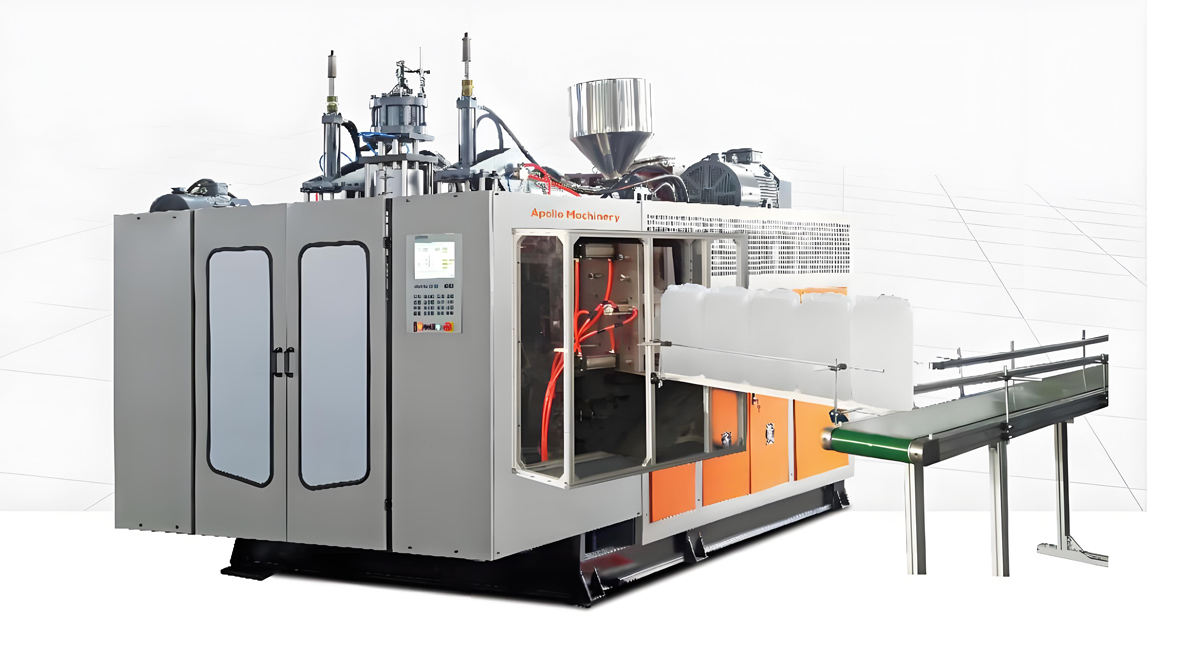
Apollo Extrusion Blow Molding Machines Recommendations for Different Hollow Plastic Products
I. Apollo Product Line Overview
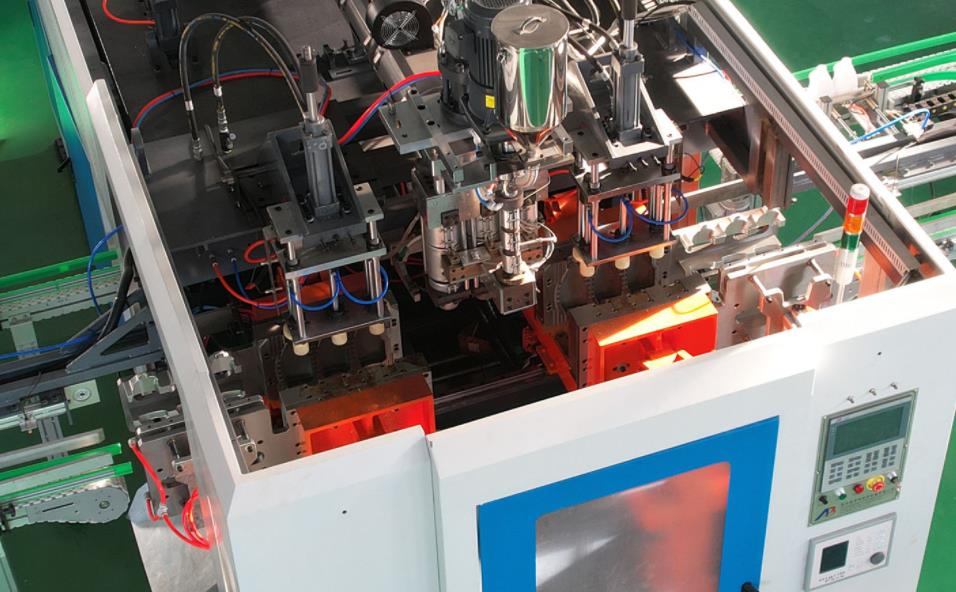
Apollo offers comprehensive extrusion blow molding solutions spanning 5ml to 5000L production capacity, with three primary series tailored to different hollow plastic product needs:
| Series | Capacity Range | Core Features | Typical Applications |
|---|---|---|---|
| ABLB Series | 200ml-30L | High-speed production (up to 1900 pieces/hr), servo-controlled, compact design | Small packaging bottles, household containers, medical vials |
| ABLD Series | 20L-1500L | Storage-type design, high clamping force, large mold capacity | Industrial tanks, chemical drums, IBC totes, pallets |
| Fully Electric Series | 200ml-30L | 30-40% energy savings, ±0.05mm precision wall thickness control, low noise | High-precision medical devices, cosmetic bottles, food packaging |
| Multi-layer Co-extrusion | 1L-1000L | Up to 5 layers, EVOH barrier capability, 2μm precision barrier layer control | Fuel tanks, high-barrier food containers, pharmaceutical packaging |
II. Apollo Machine Recommendations by Product Category
1. Packaging Hollow Products
Beverage Bottles (500ml-20L)
- Small PET/HDPE bottles (500ml-3.5L):
- ABLB 75II – Specialized for water, medical, and oil bottles with stable performance and low energy consumption
- Key features: Servo-driven system, 0.8MPa blowing pressure, 1.2m³/min air volume, ±1% wall thickness accuracy
- Production capacity: Single station – 1200 pieces/hr, double station – 1900 pieces/hr
- Large containers (5L-20L):
- ABLB 100 – 30L max capacity, 55kW screw power, 230kN clamping force
- Perfect for edible oil, detergent, and industrial liquid packaging
Food Containers (1L-50L)
- ABLB 90 (16L capacity) – PLC-controlled with color touchscreen, suitable for sauces, condiments, and bulk food storage
- Fully Electric ABLE 80/100 Series – Energy-efficient (15kW/hr vs 25kW/hr for hydraulic models) for food-grade applications requiring stability
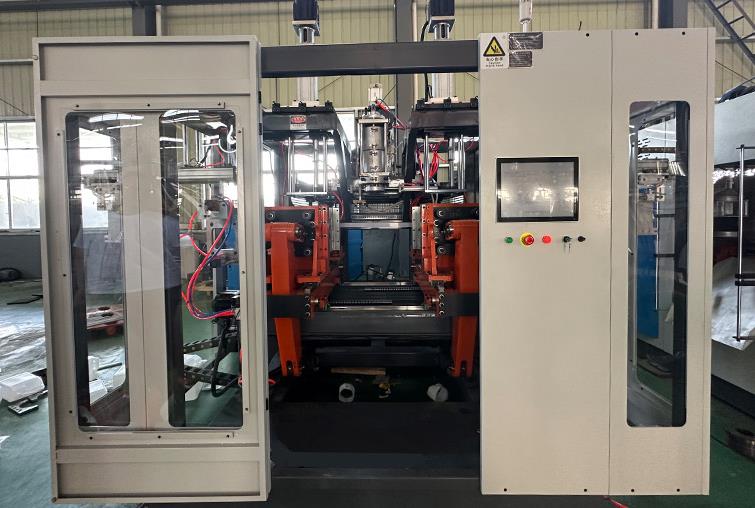
2. Industrial Container Category
Chemical Drums (20L-200L)
- ABLD 80-90 Storage Type (30L-60L) – High torque screw design for HDPE chemical-resistant containers
- Features: 100-point MOOG parison controller, 900kN clamping force, 0.8MPa blowing pressure
- Ideal for corrosive chemical packaging with uniform wall thickness (≥1.5mm) and drop resistance
Large Storage Tanks (300L-1500L)
- ABLD 120-150 Series – Heavy-duty storage-type machines:
- ABLD 120: 300L max volume, single 120mm screw, 350kg/hr output
- ABLD 150: 1500L max volume, twin 120mm screws, 840kg/hr output
- Key advantages: Storage cylinder pressure stabilization (15-18MPa), dual die heads for continuous production, and 90-second cooling cycle for large products
Pallets and Transport Containers
- ABLD 150 – Customizable for plastic pallets with special bottom blowing and material support functions
- Capable of producing heavy-duty pallets (≤50kg) with structural ribs and integrated handles
3. Automotive/Transport Category
Fuel Tanks (20L-120L)
- 5-layer Co-extrusion ABLD Series – HDPE+EVOH barrier construction:
- Multiple screw configuration (90mm/65mm/45mm/65mm/90mm) for precise layer control
- EVOH layer temperature control at 230-240°C with ±1°C precision
- Achieves ≤2g/m²·day fuel permeability
Air Ducts and Interior Parts
- Fully Electric ABLE 110 II – 30L capacity with 28:1 L/D ratio for PP-based automotive components
- Benefits: Low noise (≤75dB), no hydraulic oil contamination risk, and fast response for complex shapes
4. Daily Sundry Category
Plastic Chairs and Toys (1L-50L)
- ABLB 55/80 Series – Versatile machines for hollow furniture components and toys
- Features: Mold temperature control, optional side blowing for intricate designs
- Production efficiency: 800-1200 pieces/day for chairs, 1500-2500 pieces/day for toys
III. Apollo Machine Selection Matrix
1. By Product Volume and Type
| Product Type | Recommended Model | Key Parameters | Why Apollo? |
|---|---|---|---|
| Small bottles (≤3.5L) | ABLB 75II | Screw: 65mm, Output: 120kg/hr, Clamping: 150kN | Energy-efficient, stable operation, 30% faster cycle time than competitors |
| Medium containers (5L-30L) | ABLB 100 | Screw: 100mm, Output: 200kg/hr, Clamping: 230kN | MOOG wall thickness control, ±0.1mm precision |
| Large drums (30L-200L) | ABLD 90 | Storage: 24L, Output: 300kg/hr, Clamping: 900kN | Storage-type design prevents parison sagging |
| Industrial tanks (≥300L) | ABLD 150 | Twin screw: 120mm×2, Output: 840kg/hr, Clamping: 1800kN | Dual die heads, 40% energy savings, 15% faster production |
| Barrier products (fuel tanks) | 5-layer ABLD | Multiple screws, EVOH barrier capability | Precise layer control, 2μm barrier thickness accuracy |
| Precision medical devices | Fully Electric ABLE 80 | All-electric, 30% energy savings, noise: ≤75dB | No hydraulic oil contamination risk, ±0.05mm wall thickness |
2. By Production Requirements
High-Speed Production (>1000 pieces/hr)
- ABLB Series Double Station – Up to 1900 pieces/hr for small bottles
- Fully Electric Series – Faster response (motor delay <0.1s) for high-speed cycles
Energy Efficiency Priority
- Fully Electric ABLE Series – 30-40% less energy consumption (e.g., 15kW/hr vs 25kW/hr for 5L drums)
- ABLD Series with Servo Pump – Hydraulic models with servo oil pumps save 40% energy
Precision and Quality Critical
- Multi-layer Co-extrusion – For barrier products requiring ±2μm layer thickness control
- Fully Electric with Online Thickness Gauge – Real-time monitoring and adjustment
IV. Why Choose Apollo for Your Hollow Plastic Production?
1. Technical Advantages
- Superior Wall Thickness Control: MOOG 100-point controller ensures ±0.1mm precision (industry standard is ±0.5mm)
- Energy Efficiency: Patented servo technology reduces energy costs by 30-40%
- Multi-process Capabilities: Simultaneous support for bottom blowing, side blowing, and material support
- Mold Flexibility: Accommodates molds from 400×550mm to 1600×2200mm depending on model
2. Application-Specific Benefits
- Food/Beverage: FDA-compliant materials, no hydraulic oil leakage risk, ideal for direct food contact
- Automotive: Barrier technology for fuel tanks, lightweight designs for improved fuel efficiency
- Medical: Clean operation, tight tolerance control, suitable for sterile packaging
- Industrial: Heavy-duty construction, 24/7 operation capability, minimal maintenance
3. Cost of Ownership Benefits
- Initial Investment: 20-30% lower than comparable European brands with similar specifications
- Maintenance: Fewer moving parts (especially in electric models), 50% longer maintenance intervals
- Mold Compatibility: Standard interface design reduces mold costs by 15-20%
V. Final Selection Recommendations
- For Small Packaging Products (≤20L):
- Entry-level production: ABLB 45/55 (1L-3L) – Economical with basic automation
- Mid-range production: ABLB 80/90 (10L-16L) – Enhanced wall thickness control and production speed
- High-speed precision: Fully Electric ABLE 100 – 30% energy savings, ideal for premium packaging
- For Industrial and Large Products (≥20L):
- Chemical drums (20L-200L): ABLD 80-90 Storage Type – Eliminates parison sagging for uniform walls
- Large tanks (≥300L): ABLD 120/150 – Twin screw design for high output and heavy-duty applications
- For Automotive and Barrier Products:
- Fuel tanks: 5-layer ABLD Series – Integrates EVOH barrier layer for fuel containment
- Air ducts: Fully Electric ABLE 110 II – Low noise, precise control for complex geometries
- For Medical and Precision Products:
- Fully Electric Series – No hydraulic fluid risk, 0.05mm wall thickness precision
- ABLB 75II – Specialized design for medical vials and pharmaceutical packaging
VI. Implementation Steps
- Product Analysis: Determine volume, material, and quality requirements
- Capacity Planning: Calculate required hourly output (add 20% for future expansion)
- Machine Shortlist: Match with Apollo series based on above matrix
- Contact Apollo: Request technical consultation and factory trial (production samples)
- Final Selection: Choose model with appropriate options (wall thickness control, automation level)
Note: Apollo offers comprehensive after-sales support including 24/7 technical service, spare parts supply, and operator training to ensure seamless integration into your production line.