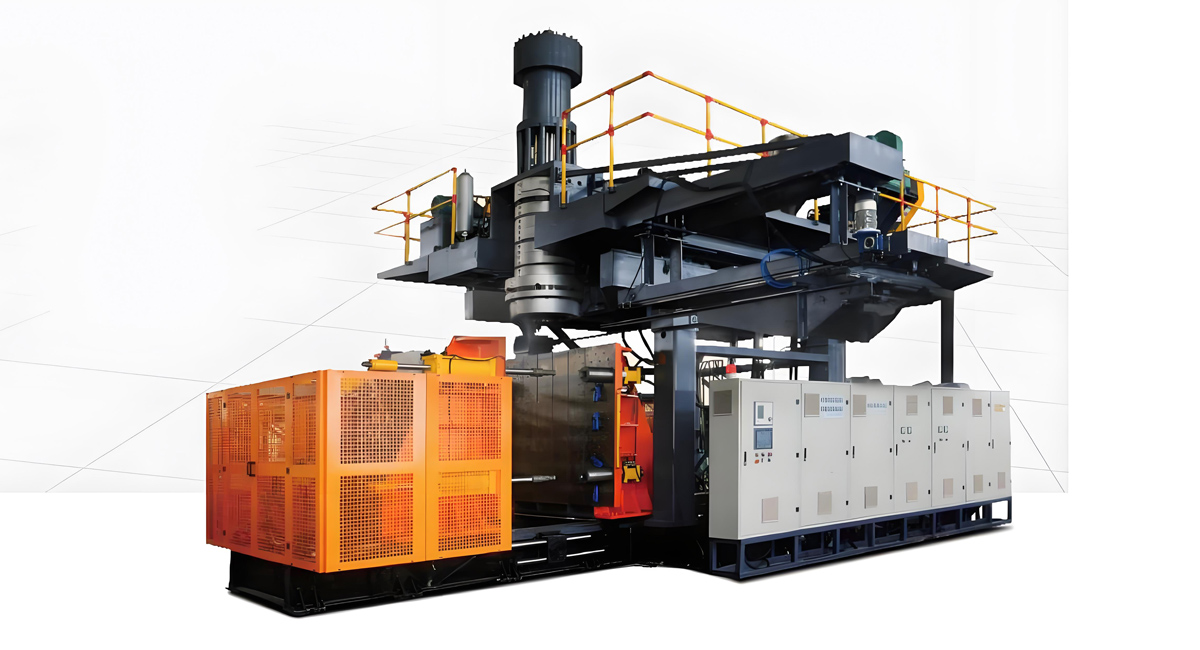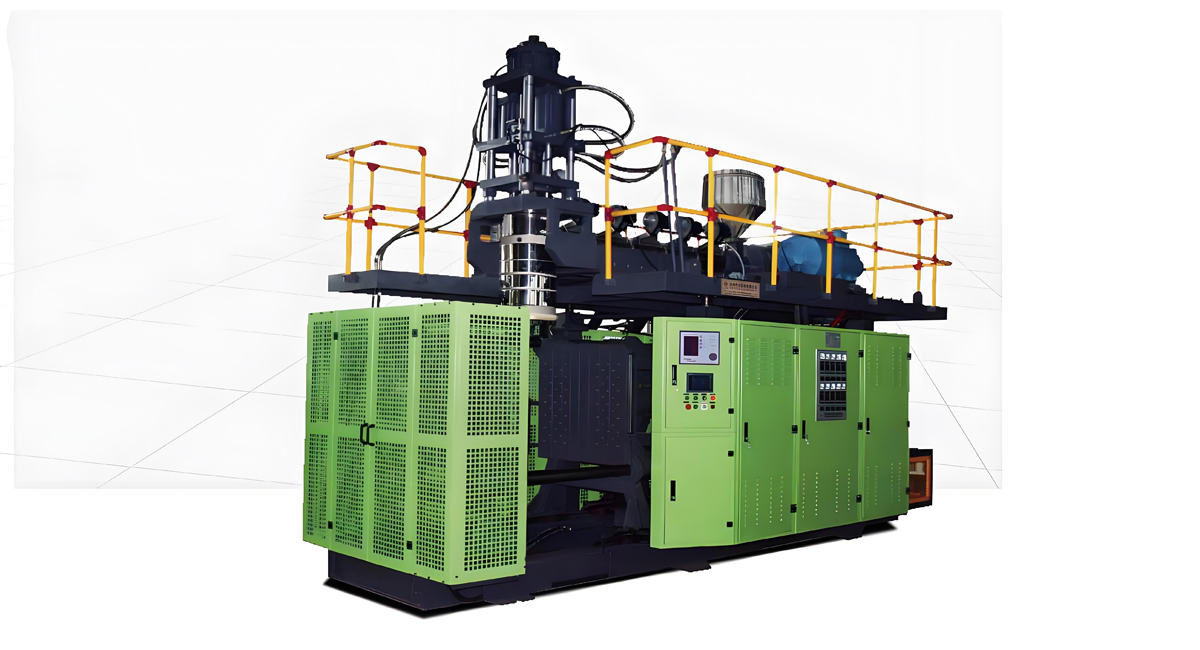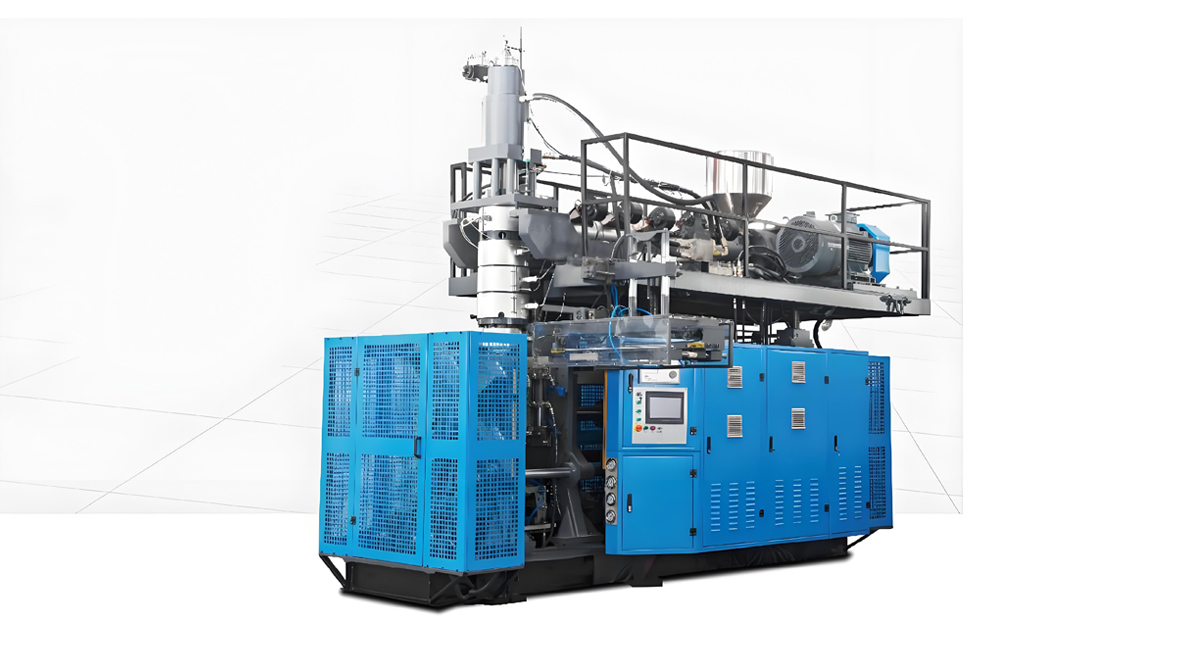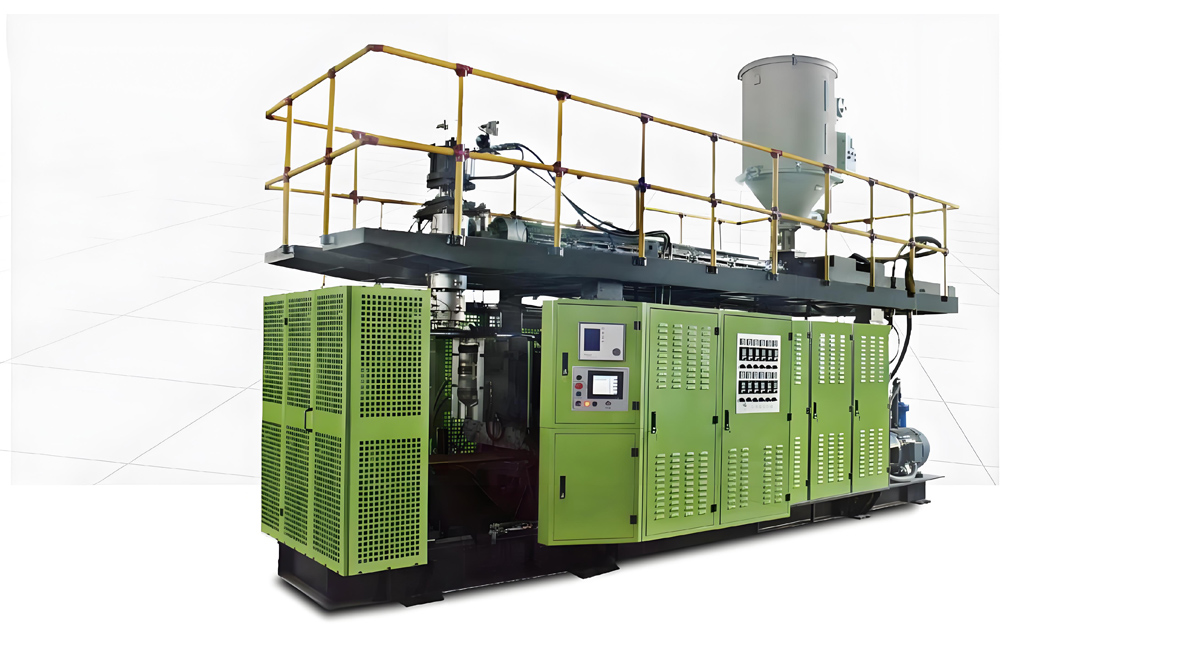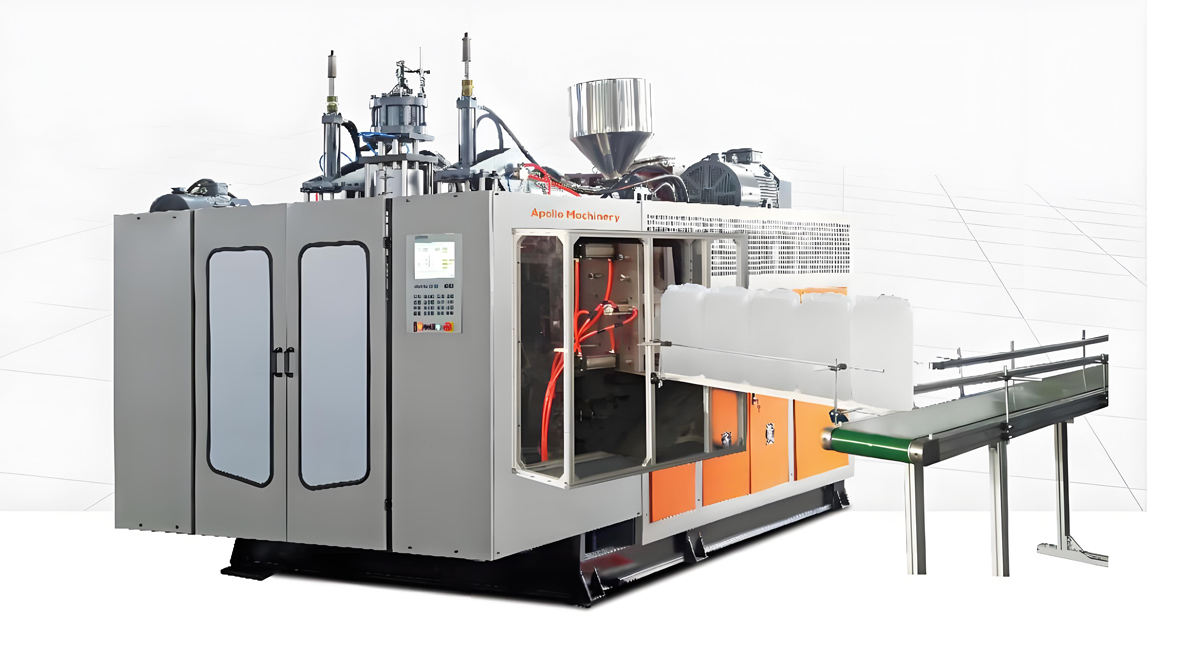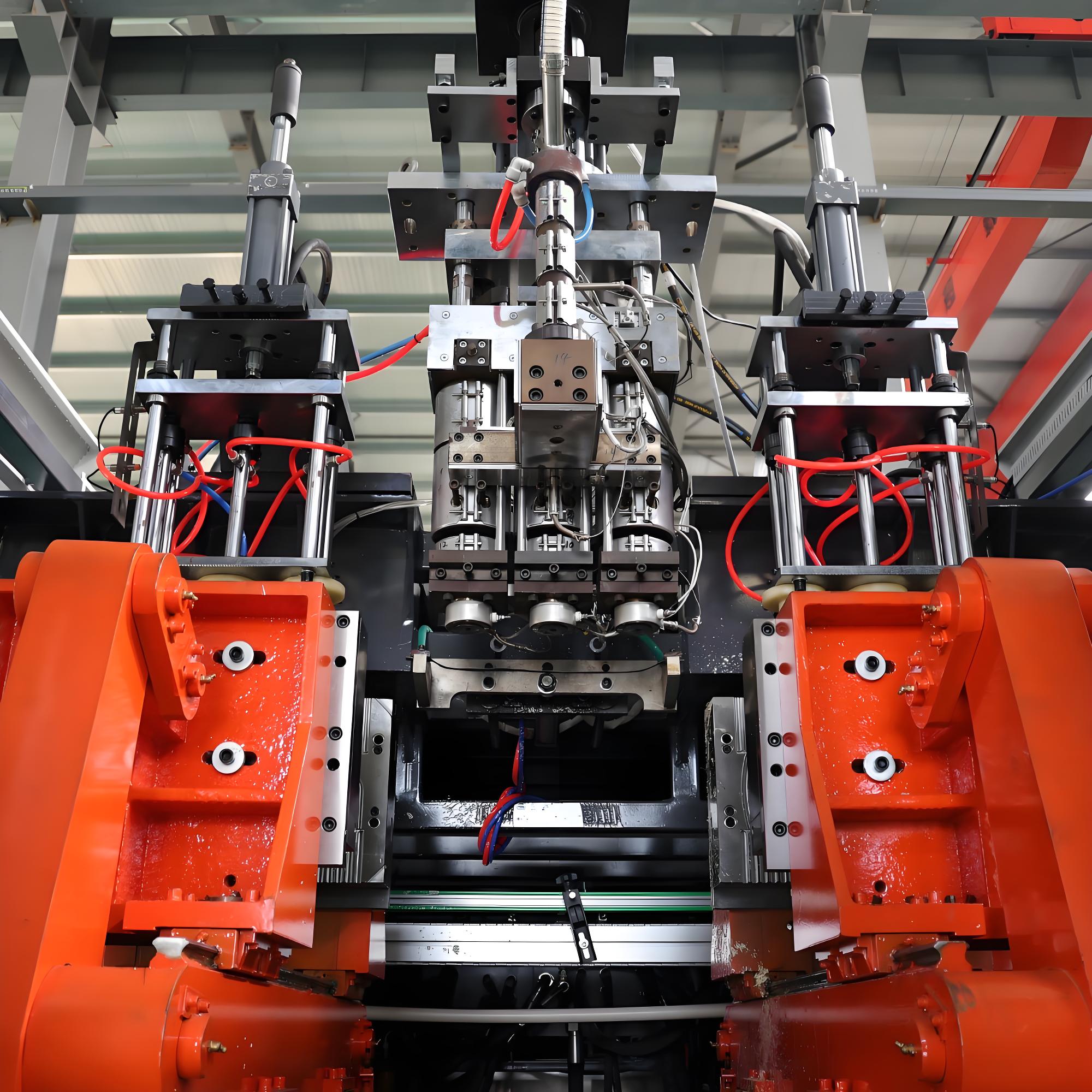

Extrusion blow molding (EBM) converts molten polymer into hollow containers that range from a few hundred milliliters for daily-chemical bottles to several hundred liters for industrial drums and tanks. Among all the cost drivers on an EBM line, raw material is almost always the largest single variable. Resin is metered by the kilogram, and every gram of polymer that leaves the machine as an overweight bottle, a scrap part, or a granulated flash edge is a direct reduction in margin. Precision parison control is the engineering discipline that decides how much polymer is placed, where along the parison length, and around which part of the circumference it is needed. This article explains how wall thickness programming, closed-loop feedback, and resin-specific compensation work together to cut give-away weight and scrap without sacrificing container performance. You will learn the mechanisms behind axial and radial wall thickness distribution, the hardware that makes sub-millimeter control achievable, the practical process windows for common resins, and a concrete lightweighting path for a 1 L HDPE detergent bottle. Apollo, a Wanplas factory, has built extrusion blow molding machines for more than twenty years, and the guidance below reflects the same principles applied across the ABLB, ABLD, and fully electric series.
Where Material Waste Comes From in Extrusion Blow Molding
Before any machine upgrade can be justified, a producer must understand where polymer is actually lost. Material waste in EBM is rarely a single problem; it is a stack of several streams, each with its own magnitude and its own remedy. The first step in any waste-reduction program is to weigh each stream separately over a representative production run, because the largest contributor is usually overweight give-away rather than visible scrap. Overweight give-away means the container meets its strength specification but carries far more polymer than the minimum required, simply because the process was set up with a generous safety margin to absorb variation. When container weight varies from shot to shot, engineers push the target weight upward to keep the lightest bottle above the failure threshold, and that upward shift is paid for on every single part.
The second stream is flash, the thin fin of material squeezed out at the parting line and at the neck and bottom trim. Flash is inevitable in EBM because the parison is larger than the cavity in those regions, but the proportion can be controlled by tighter mold alignment, sharper parison cutoff, and better neck calibration. The third stream is start-up scrap: the containers produced while melt temperature, parison program, and die gap stabilize after a changeover or a cold start. The fourth stream is material- and color-change loss, which includes purge compound, contaminated transitional melt, and the reject tail that appears when switching from one resin grade or masterbatch to another. The fifth stream is the reject rate from defects such as thin spots, burn marks, poor weld lines, or dimensional drift, which forces whole containers plus their embedded polymer into the granulator.
The table below decomposes these streams into typical share ranges observed on well-run EBM lines. These figures are offered as planning ranges rather than exact values, because the balance shifts with container size, resin, and automation level. A small cosmetic bottle made on a high-speed machine behaves differently from a 200 L industrial tank where flash is a smaller fraction of total mass but start-up scrap is larger in absolute grams.
Typical Waste Stream Breakdown on an EBM Line
| Waste stream | Typical share of total resin input | Primary lever to reduce it |
|---|---|---|
| Overweight give-away (excess wall vs. need) | 40 to 60 percent of avoidable loss | Parison wall programming + closed-loop weight control |
| Flash at parting line and neck/bottom trim | 8 to 15 percent | Mold alignment, parison cutoff, neck calibration |
| Start-up scrap after changeover or cold start | 5 to 12 percent | Warm-up recipe, faster thermal stabilization |
| Material or color change loss (purge, transition) | 10 to 20 percent of change events | Purge optimization, offline color preparation |
| Reject rate (defects, thin spots, drift) | 3 to 8 percent | Process stability, wall measurement, calibration |
The most important takeaway is that overweight give-away dominates. A line that already recovers its flash and keeps rejects low can still be wasting far more resin through an overly conservative wall profile than through all its scrap combined. That is why precision parison control, which attacks give-away directly, usually delivers the largest and fastest return among all material-saving measures. Wanplas, as the parent brand of Apollo and the other specialized factories, frames the same logic across its portfolio: the cheapest resin is the resin you never extrude.
How Parison Programming Works
Parison programming is the deliberate shaping of the parison wall as it is extruded, so that after blowing the finished container has wall thickness matched to its mechanical demands. A parison is a hollow tube of melt hanging from the die head; if its wall were perfectly uniform, the blown bottle would also be uniform, but most containers need more material at the base, at handle roots, and at impact zones than at the shoulder or sidewall. Programming lets the machine vary wall thickness at two levels: along the length of the parison, which becomes the vertical axis of the bottle, and around the circumference, which becomes the radial direction of the bottle.
Axial wall thickness control, commonly called AWDS, varies the gap between the die and the mandrel as the parison descends. When the gap closes, the local wall thickens; when it opens, the wall thins. Because the parison is extruded from the top of the bottle downward to the bottom, the axial profile directly maps to where material lands along the container height. Radial wall thickness control, referred to as PWDS or RWDS depending on the manufacturer’s terminology, rotates or shifts the mandrel or die during extrusion so that one side of the parison is thicker than the opposite side. This is essential for asymmetric parts such as handleware, where the handle side must carry far more polymer than the flat side.
The actuation behind both controls is a servo-hydraulic proportional valve driving the mandrel or a die bushing. A position transducer, usually an LVDT (linear variable differential transformer), reads the actual mandrel position and returns it to the controller, forming a closed loop that holds the commanded wall against melt-pressure and temperature disturbance. The controller steps through a stored parison curve, a list of target wall values sampled at fixed positions along the parison. The number of sample points defines the resolution of the curve and therefore how faithfully the machine can follow a complex target shape.
Resolution matters because real containers are not smooth cones. A 20-point curve can handle a simple bottle with one thick zone at the base and a thin shoulder. A 50-point curve refines that to a gentle waist and a reinforced label panel. A 100-point curve is appropriate for contoured cosmetic bottles and small handleware, while a 128-point curve gives the smoothest profile for large industrial containers and for aggressive lightweighting where every gram is being squeezed out of a demanding geometry. The table below maps control-point count to container type and to the realistic weight-reduction potential relative to a fixed uniform wall.
Parison Control Points vs. Container Type and Reduction Potential
| Control points | Best-fit container types | Relative weight-reduction potential | Notes |
|---|---|---|---|
| 20 points | Simple round bottles 200 mL to 2 L | Low to Medium | Coarse profile, one or two thick zones |
| 50 points | Contoured bottles, shampoo, lotion | Medium | Smooth waist and reinforced panel |
| 100 points | Cosmetic bottles, small handleware | Medium to High | Complex asymmetric shapes supported |
| 128 points | Industrial drums, tanks, aggressive lightweights | High | Smoothest profile, finest control |
It is worth noting that more points are not automatically better if the rest of the loop is weak. A 128-point curve commanded through a sticky valve and an uncalibrated transducer will follow the target poorly and may even increase variation. The control-point count is only as good as the actuator and sensor that execute it, which is why the next section addresses hardware. Apollo’s ABLB and ABLD series are offered with programmable wall thickness systems spanning these resolution levels, and the fully electric series adds an all-electric actuator path that removes hydraulic oil from the loop entirely for plants with high environmental requirements.
Critical Hardware for Precision Parison Control
The parison program is only a list of numbers until hardware turns it into a physical wall. Four hardware elements decide whether the commanded curve becomes the actual wall: the servo-hydraulic proportional valve, the position transducer, the die head type, and the die and mandrel geometry.
The servo-hydraulic proportional valve is the muscle. It meters hydraulic flow to move the mandrel or die bushing with speed and repeatability far beyond a simple on-off valve. Its responsiveness determines how sharply the wall can change within the short extrusion time of a parison, and its linearity determines how accurately a commanded position becomes a real position. A high-quality proportional valve holds commanded steps with minimal hysteresis, which keeps the repeated bottle consistent across thousands of cycles. In the fully electric machines the hydraulic valve is replaced by a servo motor and ball screw, which removes oil temperature effects from the loop and is attractive where cleanliness or energy use is a priority.
The position transducer closes the loop. The LVDT measures mandrel displacement with a resolution around plus or minus 0.01 mm, which is the practical floor for sub-millimeter wall control. Without that feedback the controller would be blind to whether the mandrel actually reached the commanded gap, and melt-pressure swings would silently shift the wall. The transducer must be protected from heat and contamination, and its signal should be referenced to a stable zero so that drift does not masquerade as a real wall change.
The die head type sets the physics of extrusion. A continuous extrusion head pushes melt steadily through the die so the parison forms in one continuous tube; this is common for smaller bottles and gives a naturally smooth wall but limits the mass that can be delivered quickly. An accumulator head stores a charged shot of melt and releases it rapidly for a single large parison, which is essential for industrial containers of tens or hundreds of liters where continuous extrusion would sag uncontrollably. The accumulator introduces a different challenge: the stored melt must be homogeneous and at uniform temperature, or the parison will show layered variation that no programming can fully correct.
The die and mandrel geometry, including the cone angle or taper of the mandrel and the land length of the die, sets the relationship between mandrel position and wall thickness and strongly influences melt stability. A well-designed converging land gives a stable, symmetric flow that responds predictably to gap changes, while a poorly matched cone angle promotes asymmetry, stagnation, or plate-out. Material choice matters: hardened tool steel with a wear-resistant and low-friction coating preserves the gap accuracy over long runs, and a polished flow surface reduces melt memory and degradation. The table below summarizes how these hardware choices interact with the control objective.
Hardware Elements and Their Control Contribution
| Hardware element | Role in parison control | Failure mode if neglected |
|---|---|---|
| Servo-hydraulic proportional valve | Fast, linear actuation of mandrel or die gap | Hysteresis, slow response, wall step error |
| LVDT position transducer (plus or minus 0.01 mm) | Closed-loop mandrel position feedback | Blind control, pressure-induced drift |
| Accumulator head vs continuous extrusion head | Mass delivery matched to container size | Sag or layered temperature variation |
| Die and mandrel material and cone angle | Stable, symmetric, predictable gap response | Asymmetry, plate-out, premature wear |
Apollo machines are built to these principles and share the Wanplas group’s quality baseline, including CE conformity for the machinery and ISO-aligned quality management. When a buyer evaluates an EBM machine for material savings, the question should not be only the number of control points but whether the valve, transducer, head, and die are engineered as one coherent loop. Competitors such as Bekum, Kautex, and Uniloy follow similar architectures, and a fair comparison weighs the whole actuation-and-sensing chain rather than a single specification line.
Closed-Loop Feedback Systems
Programming the parison is open-loop control: the machine follows a stored curve and hopes the result is right. Closed-loop feedback closes the gap between the commanded wall and the measured container, and it is the difference between a one-time saving demonstrated in the lab and a saving that survives resin lot changes, ambient temperature swings, and operator turnover. Three feedback layers are relevant: in-line weight feedback, ultrasonic wall thickness measurement, and visual flash detection.
In-line weight feedback weighs a sample of finished containers on a checkweigher and feeds the average and standard deviation back to the controller. If the average drifts above target, the controller trims the parison curve downward; if it drops toward the failure limit, it adds material. This loop directly attacks give-away because it lets the target sit just above the true minimum instead of a distant safety margin. The more powerful effect is on variation. When container weight standard deviation is reduced from roughly plus or minus 2.5 percent to plus or minus 0.5 percent, the lightest bottle in a batch is much closer to the average, so the whole batch can be lightened without increasing the risk that any single bottle fails. In index terms, if a baseline process sits at 100 index points of safety margin, tightening variation can reclaim a large share of that margin as real gram-weight savings.
Ultrasonic wall thickness measurement scans the blown container non-contactly and reports the actual wall at multiple points, especially at the base, handle, and shoulder where failure concentrates. Unlike weight, which only sees the total, wall measurement sees the distribution, so it can catch a bottle that is light overall but dangerously thin at one spot. This is the feedback that makes aggressive profiles safe, because the engineer can confirm that the thin zones are still above the design minimum. Visual flash detection uses a camera or simple sensor at the trim station to flag parts with abnormal flash, which often signals a die-gap or mold-alignment drift before it becomes a weight problem.
Together these loops form a hierarchy. Wall measurement guards quality at the critical points, weight feedback guards the total and the variation, and flash detection guards the process health. A plant that installs all three can run a thinner, lighter container with equal or better assurance than a plant running a heavy, conservative one. The table below contrasts the open-loop and closed-loop regimes in plain performance terms.
Open-Loop vs. Closed-Loop Parison Control
| Attribute | Open-loop (stored curve only) | Closed-loop (feedback active) |
|---|---|---|
| Weight standard deviation | Around plus or minus 2.5 percent | Around plus or minus 0.5 percent |
| Required safety margin | High | Low |
| Response to resin lot change | Manual re-tune | Automatic trim |
| Thin-spot detection | None | Ultrasonic wall scan |
The practical implication is that closed-loop control converts material saving from a fragile optimization into a robust, self-correcting process. For a producer running multiple shifts and multiple resin suppliers, that robustness is often worth more than the raw gram saving itself, because it protects the saving against the chaos of real factory conditions.
Resin Behavior and Parison Curve Compensation
No parison program is resin-agnostic. The same die gap and curve produce different walls in different polymers because each resin sags, recovers, and freezes at its own rate. Sag is the downward stretching of the parison under its own weight during the brief moment it hangs before the mold closes. A resin with low melt strength sags more, thinning the upper parison and thickening the lower parison, which is the opposite of where material is usually needed. The parison curve must compensate by thickening the upper zones when sag is severe.
HDPE is the workhorse of EBM for daily-chemical and industrial containers. With a melt flow rate (MFR) in the range of 0.3 to 1.0 grams per ten minutes, it has moderate melt strength and a manageable sag, which is why it is forgiving for beginners yet still benefits strongly from programming. PP has lower melt strength at processing temperature and sags more than HDPE, so its curve needs stronger upper-zone compensation and often a lower melt temperature to keep the parison from over-stretching. PETG and PC have higher melt strength and resist sag, allowing thinner upper walls and opening the door to lighter containers, though their higher processing temperatures and sensitivity to degradation demand careful drying and thermal control. PVC, ABS, and PA each bring their own flow and thermal constraints and are handled on Apollo machines rated for those materials.
Regrind, the granulated flash and reject material returned to the hopper, changes the parison behavior too. A regrind ratio of 10 to 30 percent is stable for most daily-chemical HDPE applications and is environmentally sound because it closes the loop on in-plant scrap. Above that range, pellet-size distribution, moisture uptake, and minor contamination begin to disturb melt homogeneity, which shows up as parison flicker and wall variation. The remedy is a controlled blender, proper drying, and dedusting so that fines do not accumulate in the melt. The table below maps each common EBM resin to its sag tendency and the compensation it needs in the parison curve.
Resin-Specific Parison Curve Compensation
| Resin | Typical MFR window (g/10 min) | Sag tendency | Parison curve compensation |
|---|---|---|---|
| HDPE | 0.3 to 1.0 | Moderate | Mild upper-zone thickening |
| PP | 1.0 to 4.0 | High | Strong upper-zone thickening, lower melt temp |
| PETG | Medium range | Low | Thinner upper walls possible |
| PC | Medium range | Low | Thinner upper walls, strict drying |
| HDPE plus 10 to 30 percent regrind | Depends on virgin | Slightly higher variation | Tighter feedback, drying, dedusting |
The material dimension is where the Wanplas group’s breadth helps. Apollo focuses on the blow molding machine, but sister factories cover the surrounding chain: Kerke supplies twin-screw compounding extruders for masterbatch and modified resin, Polyretec builds washing and pelletizing lines that turn post-consumer scrap into clean flake, and YuanSu runs film, sheet, and board extrusion. A producer optimizing parison control on an Apollo line therefore sits inside a group that understands polymer behavior end to end, which matters when a resin change is being considered to enable a lighter container.
Process Window for Low-Waste Molding
Parison control does not operate in isolation; it rides on top of a stable process window. If the melt temperature, die head zoning, blow pressure, and cycle time are wrong, no amount of programming will produce a consistent light container. The window below is expressed as ranges rather than single values, because the optimum depends on resin grade, container size, and machine style.
For HDPE the melt temperature typically sits between 175 and 195 degrees Celsius. The die head is usually divided into independently controlled zones, with the mandrel and die land zones set slightly cooler than the adapter to control sag without freezing the flow. Running hot reduces pressure and can smooth the wall but increases sag and plate-out and accelerates degradation; running cool raises melt pressure, stresses the proportional valve, and worsens wall uniformity. The art is to find the middle of the window where sag is manageable and the wall is stable. Blow pressure for EBM commonly ranges from 6 to 10 bar, enough to push the parison against the cavity and replicate surface detail without over-stressing the mold or the part. Cycle time interacts with waste because a faster cycle means more parts per hour from the same resin, effectively lowering the resin cost per container, but an aggressive cycle can shorten parison cooling and distort the wall. The balance is set per container.
The table below collects these parameters as a quick reference. Values are typical ranges for guidance and must be confirmed against the resin datasheet and the machine manual; the Wanplas service policy includes on-site installation and commissioning so that the window is established on the actual line rather than copied from a generic table.
Typical Process Parameter Ranges for EBM
| Parameter | Typical range | Effect on waste if off-target |
|---|---|---|
| HDPE melt temperature | 175 to 195 degrees Celsius | Too hot increases sag; too cold raises pressure |
| Die head zone temperature | Zoned, near melt temp | Poor zoning distorts wall profile |
| Blow pressure | 6 to 10 bar | Low pressure leaves thin incomplete walls |
| Cycle time | Set per container size | Too short distorts wall; too long wastes capacity |
| Regrind ratio | 10 to 30 percent | Above range raises variation |
Food and pharmaceutical contact containers carry an extra constraint. HDPE for such applications must meet food-contact requirements such as FDA in the United States or EU 10/2011 in Europe, and the resin grade, regrind source, and cleaning must respect those rules. Detergent and industrial containers are less constrained but still benefit from consistent, clean material. Apollo applications span food and beverage, daily chemical, chemical, building material, medical and pharmaceutical, and automotive, so the same machine family must serve both strict and relaxed compliance environments, and the process window is part of that flexibility.
Lightweighting Case: 1 L HDPE Detergent Bottle
A concrete example makes the mechanism tangible. Consider a 1 L HDPE detergent bottle produced on a continuous extrusion EBM line at a baseline gram weight of 42 grams per bottle. The bottle passes drop and top-load tests with margin to spare, which means part of that 42 grams is give-away. The goal is to reduce the gram weight without raising the reject rate or failing any performance test.
The first move is measurement. An ultrasonic wall scan shows the base is over-specified by a wide margin while the sidewall is near its minimum. The parison curve is reprogrammed to move wall from the base toward the handle and label panel, a shift that alone brings the bottle to about 39 grams. The second move is closed-loop weight feedback. With the standard deviation still around plus or minus 2.5 percent, the target cannot drop further without risk, so the checkweigher loop is engaged and the variation is tightened toward plus or minus 0.5 percent. Once variation is low, the target can be lowered with confidence, bringing the bottle to about 36 grams. The net change is a reduction of 6 grams, roughly 14 percent lighter than the baseline, achieved entirely through parison control and feedback rather than a resin change.
Expressed as an index, if the baseline embodied 100 index points of resin per bottle, the optimized bottle embeds about 86 index points, a saving of 14 index points on every unit. Scaled across a high-volume run, that percentage compounds into a large absolute reduction in resin throughput, which is the practical meaning of cutting raw material cost without touching the price of resin itself. Crucially, the drop test and top-load remain within specification because the wall was redistributed, not merely removed; the critical zones are protected while the over-built zones are trimmed.
This case also illustrates why the whole loop matters. A 20-point program might achieve the 39 gram redistribution but would struggle to hold the final 36 gram target consistently; the 50 or 100 point resolution plus the feedback loop is what makes the last few grams safe. It further shows that lightweighting is a process discipline, not a one-time setting. Resin lot changes, seasonal ambient swings, and mold wear all nudge the wall, and only the feedback loop preserves the saving over months of production.
Flash Recycling Closed Loop
Even a perfectly controlled parison leaves flash at the parting line and trim. The sustainable and economical move is to recover that flash rather than discard it. The closed loop begins at the trim station, where flash and skeleton are conveyed to an inline granulator that cuts the edge into uniform regrind pellets. Uniform pellet size is important because mixed flake sizes feed unevenly and disturb the parison, so the granulator setting and screen size are chosen for consistency.
The regrind is then metered back into the virgin stream through a controlled blender that holds the ratio in the stable 10 to 30 percent band. Ratio control is the key discipline: too little regrind wastes recoverable material, while too much degrades the parison. Because in-plant flash is clean and single-source, it is far easier to reuse than post-consumer scrap, and it carries none of the contamination risk of mixed waste. After blending, the mix passes through drying and dedusting so that moisture and fines do not enter the melt; moisture causes splay and weakness, and dust accumulates in the head and shifts the wall.
This in-plant loop is distinct from post-consumer recycling, but the two connect through the Wanplas group. Polyretec, a Wanplas factory, builds washing and pelletizing lines that upgrade post-consumer bottles into clean flake and pellets, and Kerke supplies the twin-screw extruders that compound those recyclates with virgin resin or additives. A producer running an Apollo blow molder can therefore extend the same closed-loop thinking from in-plant flash to recycled content, provided the recyclate is properly cleaned and the parison program is adjusted for its slightly different flow. The waste-source table at the start of this article maps flash to a Medium relative benefit when recovered, because the gram saving is real but smaller than the give-away saving addressed by parison programming.
Maintenance and Calibration Checklist
Precision parison control degrades silently if the hardware is not maintained. A worn die lip, a contaminated transducer, or a sticky valve will shift the wall long before a human notices, and the feedback loop may compensate by adding material, quietly eroding the saving. A disciplined preventive-maintenance plan protects the investment.
The parison curve should be re-checked against actual container weight and wall measurement on a quarterly basis, or more often for demanding lightweighting programs. The re-check compares the stored curve to the measured result and corrects drift from die wear or material change. The servo-hydraulic proportional valve should be cleaned and its response verified on the machine’s scheduled service, because hydraulic contamination is the most common cause of step error. The LVDT transducer should be checked for zero stability and protected from heat, since a drifting zero reads as a false wall change. The die lip deserves its own inspection cycle, because wear or buildup at the lip changes the extrusion gap and distorts the whole profile; early wear shows as a slight asymmetry that grows into visible thin spots.
The checklist below is a practical starting point. It assumes a plant already running an Apollo ABLB, ABLD, or fully electric machine with a programmable wall thickness system, and it aligns with the Wanplas shared service promise of on-site installation, commissioning, and tracked usage status. Plants with multiple resin grades should keep a separate stored curve and calibration record per grade, because the optimum program differs by material.
Preventive Maintenance and Calibration Checklist
| Task | Frequency | Why it protects material savings |
|---|---|---|
| Re-check parison curve vs measured wall and weight | Quarterly (monthly for aggressive lightweights) | Catches drift before give-away returns |
| Clean and verify servo-hydraulic proportional valve | Per scheduled service | Prevents step error and hysteresis |
| Check LVDT transducer zero and signal | Per scheduled service | Avoids false wall readings |
| Inspect die lip for wear and buildup | Per scheduled service | Preserves symmetric extrusion gap |
| Verify regrind blender ratio and dedusting | Continuous, with periodic audit | Keeps parison stable with reused flash |
Operators should be trained to read the checkweigher trend, not just the alarm. A slow upward creep in average weight is the earliest signal that the loop is compensating for wear, and catching it early preserves both material and mold life. Wanplas’s group promise of a quality standard with refund and compensation if quality fails reinforces the importance of keeping the process within the validated window; a maintained machine is a machine that stays within that window.
Frequently Asked Questions
What is parison control in extrusion blow molding?
Parison control is the programmed variation of parison wall thickness along its length and around its circumference during extrusion. Axial wall thickness control (AWDS) varies thickness from top to bottom, while radial or programmable wall thickness distribution (PWDS/RWDS) varies it around the mandrel. The goal is to place polymer only where the finished container needs strength, eliminating give-away weight.
How many parison control points do I need?
Small simple bottles such as 200 mL to 2 L containers are well served by 20 to 50 control points. Complex shapes, handleware, and asymmetric containers benefit from 100 points, while large industrial drums and very demanding lightweighting targets use 128 points for the smoothest wall profile and the highest gram-weight reduction potential.
Why does HDPE sag more than PETG during parison extrusion?
Sag is driven by melt strength and shear-thinning behavior at processing temperature. HDPE with a low melt flow rate has moderate melt strength and tends to stretch under its own weight, so the parison curve must thicken the upper zones. PETG and PC have higher melt strength and resist sag, allowing thinner upper walls. PP sags the most among common EBM resins and needs the strongest upper-zone compensation.
Can regrind be reused directly in blow molding?
Yes, flash and rejected parts are granulated and blended back into the virgin stream. For most daily-chemical HDPE applications a regrind ratio of 10 to 30 percent is stable. Above that range, pellet-size distribution, moisture, and contamination begin to disturb parison uniformity, so drying, dedusting, and a controlled blender become necessary.
What melt temperature should be used for HDPE blow molding?
The typical melt temperature window for HDPE is 175 to 195 degrees Celsius, with the die head often divided into independently controlled zones. Running too hot increases sag and plate-out, while too low a temperature raises melt pressure and worsens wall uniformity. The optimum sits in the middle of the window and is tuned per resin grade.
How much material can precision parison control save?
With a closed loop that tightens container weight standard deviation from roughly plus or minus 2.5 percent to plus or minus 0.5 percent, a producer can safely lower the target gram weight without increasing reject risk. A representative 1 L HDPE detergent bottle moves from 42 grams to 36 grams, about a 14 percent reduction, while keeping drop performance and top-load within specification.
How often should the parison program be re-calibrated?
A quarterly re-check of the stored parison curve against actual container weight and wall measurement is a sound baseline. The servo-hydraulic proportional valve and LVDT transducer should be cleaned and verified on a scheduled preventive-maintenance plan, and the die lip inspected for wear or buildup that would shift the extrusion gap and distort the wall profile.
Conclusion
Material waste in extrusion blow molding is a stack of streams, and overweight give-away is almost always the largest of them. Precision parison control attacks that stream at its root by placing polymer only where the container needs it, then protects the saving with closed-loop feedback that holds variation low. The mechanism is straightforward in principle and powerful in practice: tighten the weight standard deviation, drop the target with confidence, and the gram saving compounds across every bottle in the run. Hardware choices, from the servo-hydraulic proportional valve and the plus or minus 0.01 mm LVDT transducer to the die head type and die geometry, decide whether the commanded curve becomes the real wall. Resin behavior, especially sag and regrind stability, decides how the curve must be shaped, and the process window of melt temperature, blow pressure, and cycle time decides whether the loop is stable enough to trust.
Apollo, a Wanplas factory with more than twenty years in extrusion blow molding and over four thousand machines running in more than ninety countries, builds the ABLB, ABLD, and fully electric series to these principles, and the Wanplas group surrounds the blow molder with compounding, recycling, and extrusion expertise from its sister factories. For a producer weighing a material-cost program, the recommendation is to start with measurement, install wall and weight feedback, and re-calibrate on a schedule, because the cheapest resin is the resin you never extrude. Relative effort and return can be summarized as Low for basic programming, Medium for feedback installation, and High for full closed-loop lightweighting with maintenance discipline, and the path is repeatable from a small daily-chemical bottle to a large industrial container.