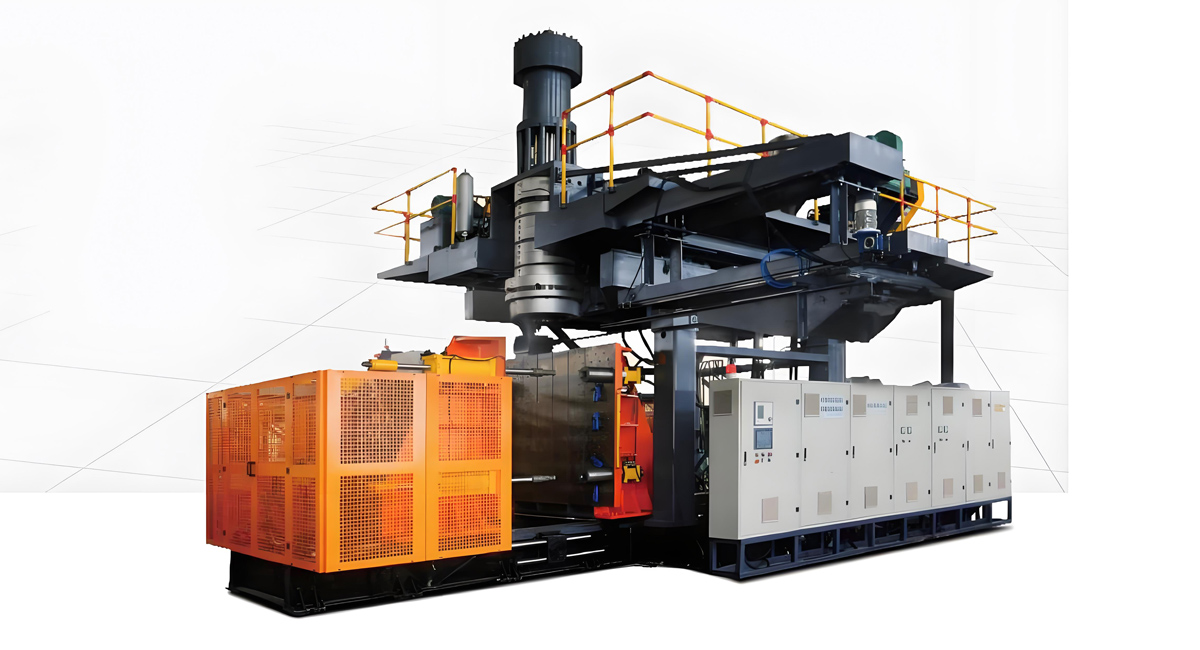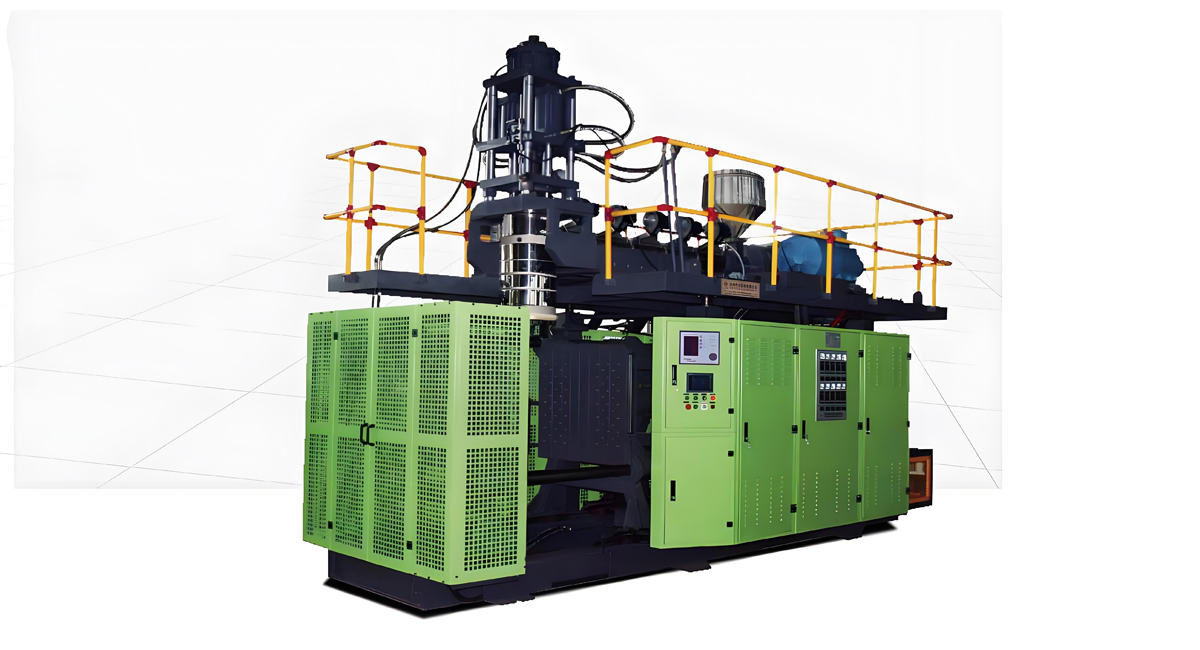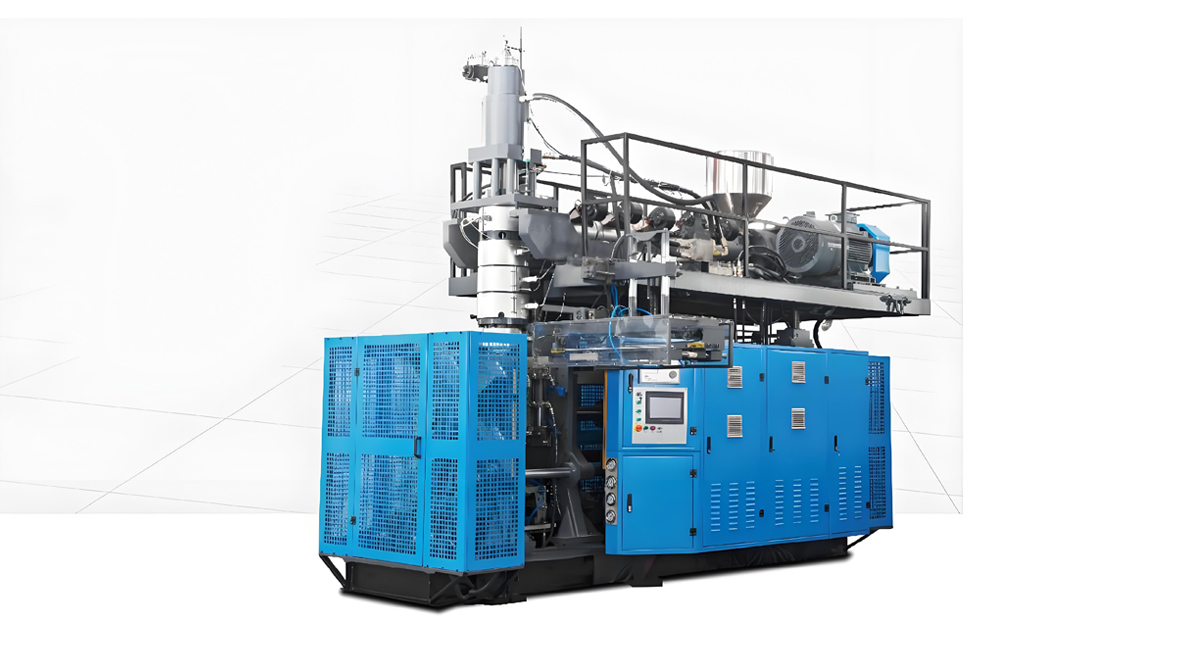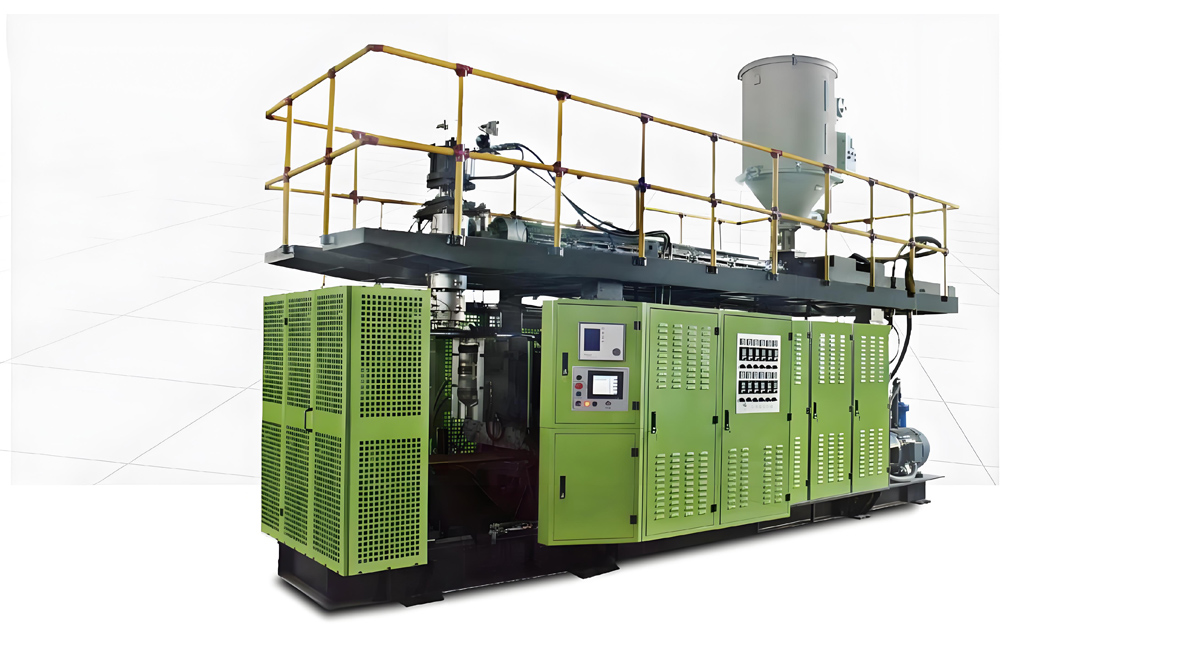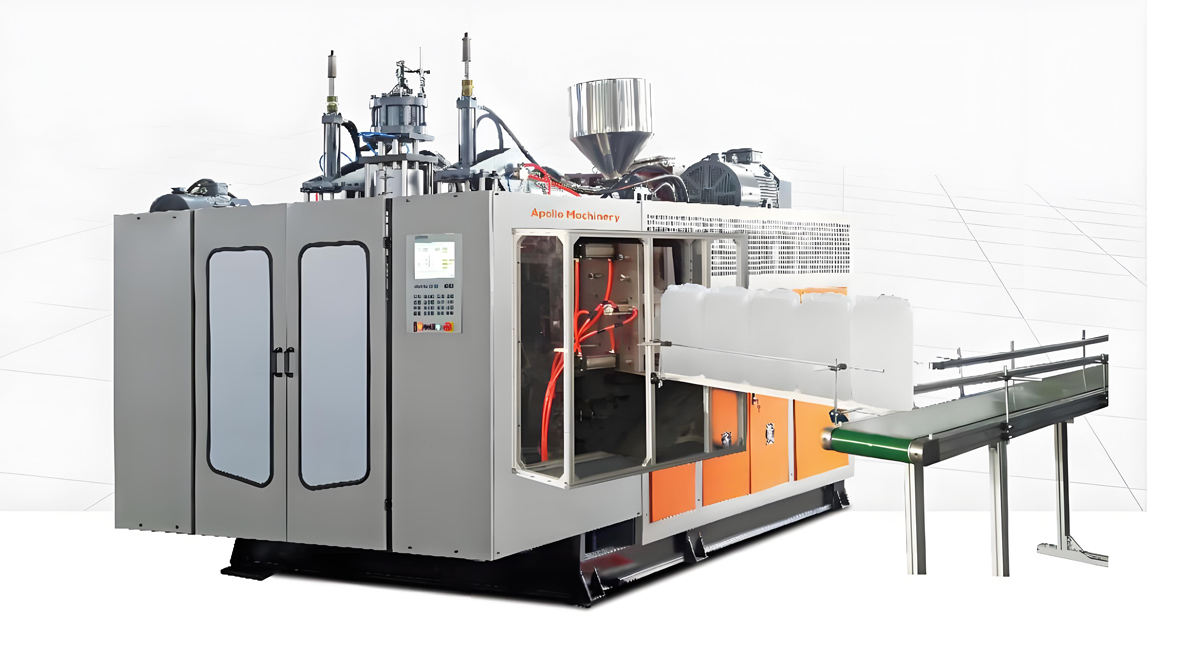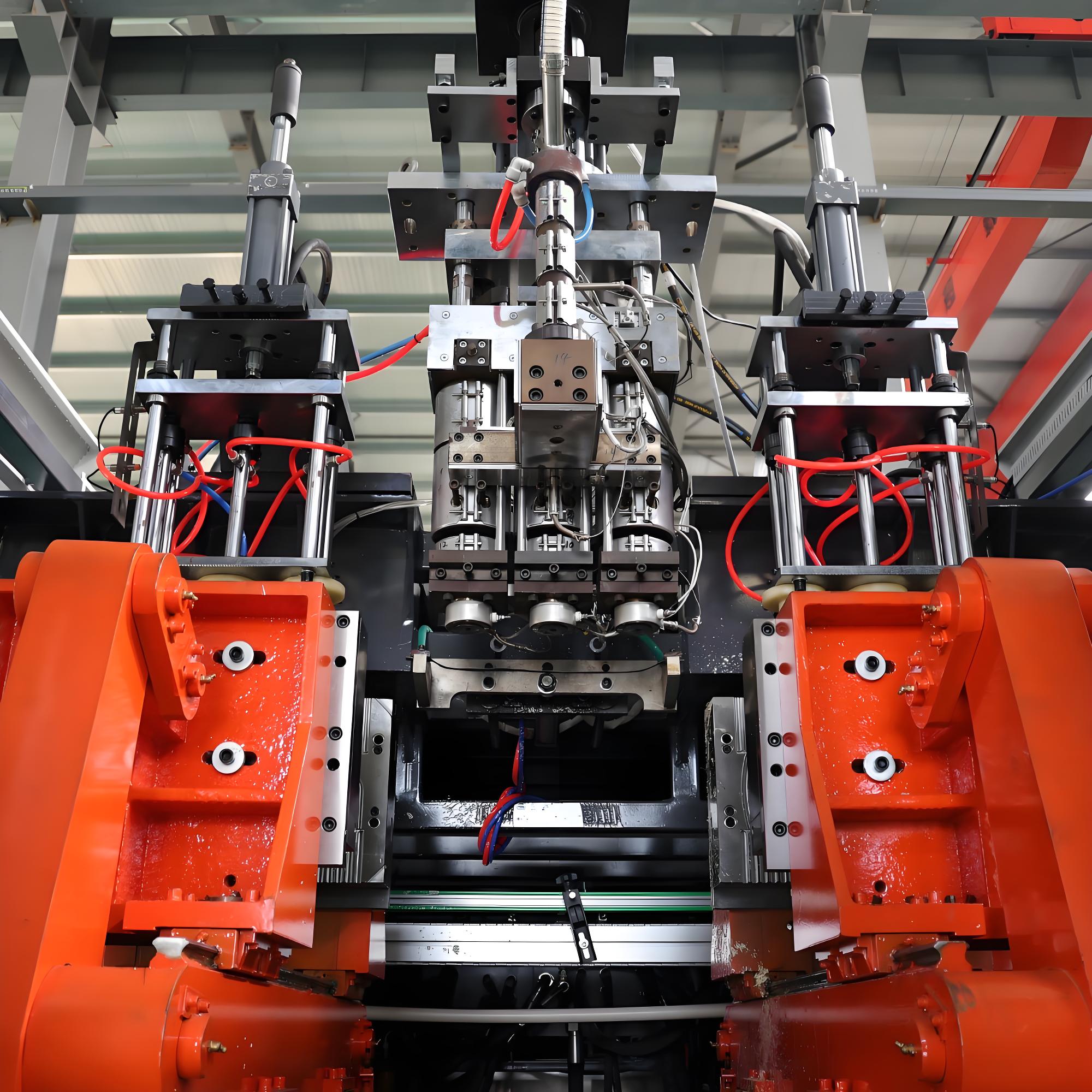

Automatic extrusion blow molding lines have become the most reliable route for hollow-container producers to take manual labor out of the production chain without sacrificing output or quality. In blow molding, the extrusion process forms a hot tube of melt called a parison, which is captured in a mold and inflated with compressed air until it takes the shape of the cavity. The physical nature of that process — hot parison handling, flash trimming, leak checking, labeling, and packing — has historically depended on a long row of human hands. For plants running a three-shift pattern, those hands multiply into a standing workforce of thirty people or more just to keep one cell running. This article explains, with concrete factory case data, how an automatic extrusion blow molding line removes those manual roles one module at a time, what the headcount and per-capita output numbers look like in practice, and how the change translates into an indexed labor-cost reduction and a payback measured only in months.
We focus strictly on labor substitution and verified plant results. The companion discussion of energy, material yield, and cycle-time reduction for high-efficiency EBM machines is treated separately; here the lens is people, roles, and the measurable drop in direct manual effort when a semi-automatic cell is upgraded to a fully automatic one. Apollo, a Wanplas factory specializing in extrusion blow molding (EBM) machines for more than twenty years, has accumulated installation and retrofitting experience across more than ninety countries, and the patterns described below reflect that field experience rather than theoretical models.
Readers should leave with a clear picture of which roles disappear first, how many operators remain after automation, how quality and OEE move, and how to express the business case in a way that survives any labor market — by counting heads, pieces per person per shift, percentage reduction, an indexed baseline of 100 points, and payback in months instead of quoting any remuneration or currency.
The Hidden Burden of Manual Labor in Semi-Automatic EBM Lines
Labor is the quiet variable that decides whether a blow molding investment pays back on schedule. A semi-automatic extrusion blow molding line looks simple from the outside: a plasticizing barrel melts the resin, the parison is extruded, the mold closes, and a bottle drops out. The complexity is hidden in everything that happens around that bottle after it leaves the mold. Someone must load resin, someone must watch the machine, several people must remove flash, someone must leak-test, someone must label, several must pack, and a supervisor must coordinate. Each of those roles is a fixed cost that scales with shifts, not with cleverness.
The structural problem is that semi-automatic lines break the work into many small manual tasks that cannot easily be merged. Flash removal alone can consume two or three people on a busy bottle line because the trimmed neck and body scrap must be handled, sorted, and returned or scrapped. Leak testing by manual sampling leaves a quality gap that forces extra downstream inspection. Labeling and packing are repetitive but labor-intensive, and they are exactly the tasks where consistency suffers late in a long shift. The result is a workforce that is large, variable in output, and difficult to scale during demand peaks without hiring.
Manual labor on a semi-automatic EBM line is not a single cost — it is a stack of ten or more roles per shift that compounds three times under a three-shift pattern and caps both quality and output consistency.
Automation attacks this stack directly. Instead of asking one operator to do many things, a fully automatic line asks a small team to supervise many machines doing the work themselves. The economic logic is straightforward: a machine running deflashing, leak testing, vision, labeling, and packing does not take breaks, does not tire in the last hour of a shift, and does not vary its reject rate with mood or fatigue. The sections that follow quantify exactly how many roles vanish and what remains.
Anatomy of a Three-Shift Semi-Automatic Blow Molding Cell
To understand the savings, we must first count the people. A representative semi-automatic extrusion blow molding cell producing bottles or small drums on a three-shift pattern typically carries the following direct roles per shift: one feeder who replenishes resin and manages the drying hopper, one machine watcher who monitors parison formation and clears minor jams, two to three flash-removal workers who trim the bottle body and neck, one leak tester performing sample or full manual checks, one labeler, two packers who place finished containers into cases, one quality-control inspector, and one shift leader. That is ten to eleven people per shift before any floating relief or material handler is added.
Under a three-shift operation the arithmetic is stark. At ten people per shift, three shifts equal thirty direct operators every day. At eleven per shift, the daily direct headcount reaches thirty-three. Add a small floating layer for breaks, absenteeism, and weekend coverage and the effective standing workforce for one cell can approach forty. Multiply that by several cells on a plant floor and the manual labor base becomes the dominant fixed cost of the operation, far larger than the energy or even the resin in many bottle and drum applications.
The table below contrasts this baseline with a fully automatic configuration running the same output. The fully automatic line keeps one patrol inspector and half a maintenance technician per shift — a deliberate fractional allocation because a single skilled technician covers multiple lines. This is the central comparison that frames every case study later in the article.
Semi-Automatic Versus Fully Automatic Staffing
| Role / Function | Semi-Automatic (per shift) | Fully Automatic (per shift) | Manual Roles Removed |
|---|---|---|---|
| Resin feeding and hopper care | 1 | 0 (central feeding) | 1 |
| Machine watching | 1 | 0.3 (patrol) | 0.7 |
| Flash removal / deflashing | 2 to 3 | 0 (in-line deflash) | 2 to 3 |
| Leak testing | 1 | 0 (auto 100% test) | 1 |
| Labeling | 1 | 0 (auto label) | 1 |
| Packing into cases | 2 | 0 (auto packer) | 2 |
| Quality control inspection | 1 | 0.2 (vision system) | 0.8 |
| Shift leader | 1 | 0 (centralized) | 1 |
| Maintenance technician | 0 (reactive) | 0.5 (planned) | n/a |
| Total per shift | 10 to 11 | 1.5 | 8.5 to 9.5 |
| Three-shift daily total | 30 to 33 | 4.5 | ~85% reduction |
The fractional entries in the automatic column reflect shared coverage: one patrol inspector walks several lines, and one maintenance technician is allocated at half a head per line because planned preventive maintenance is spread across the week. The headline conclusion is an approximately 85 percent reduction in direct manual headcount for the same throughput, which is the single most important number in any labor-saving business case for automatic extrusion blow molding lines.
Automation Modules That Replace Operators Step by Step
A fully automatic line is not one machine but a chain of modules, each of which deletes a manual role. Understanding the chain lets a plant phase the investment: it can start by removing the most expensive or most error-prone roles and add modules later as the business case matures. Below is the full module map, followed by deeper sections on the most impactful ones.
- Central feeding system — vacuum loading, drying hopper, and gravimetric blending remove the feeder role and stabilize material consistency.
- Automatic parison cut-off and flash recovery — hot parison separation plus crusher and return conveyor close the scrap loop and remove manual flash handling.
- Take-out robot — a 6-axis or gantry robot removes the finished bottle and presents it to downstream stations.
- In-line deflashing and neck milling — trims body flash and reams the bottle neck to specification without human touch.
- 100 percent leak testing — differential-pressure stations test every bottle, replacing manual sampling.
- Vision inspection — cameras check body, neck, color, streaks, and wall thickness, replacing visual QC.
- Automatic labeling and coding — label applicators and inkjet printers mark every unit.
- Automatic packing and palletizing — case packers and palletizing robots replace manual case loading.
The table below scores each module by the labor it removes and how difficult it is to implement. Implementation difficulty is rated Low, Medium, or High based on integration effort, not on cost, because cost expression is intentionally avoided in this article.
Automation Module, Function, Labor Replaced, and Difficulty
| Automation Module | Primary Function | Manual Roles Replaced | Implementation Difficulty |
|---|---|---|---|
| Central feeding | Vacuum load, dry, gravimetric blend ±0.5% | Feeder (1/shift) | Low |
| Parison cut-off + flash recovery | Hot cut, crush, convey regrind 20-35% | Flash handling (partial) | Medium |
| Take-out robot | Pick at 1.2-2.5 s/cycle | Bottle transfer (1/shift) | Low |
| In-line deflashing + neck mill | Trim flash, ream neck | Deflashers (2-3/shift) | Medium |
| Leak testing station | Differential 0.5-3 kPa, 0.05 mm pore | Leak tester (1/shift) | Medium |
| Vision inspection | Body/neck/color/streak/wall | QC inspector (1/shift) | High |
| Labeling + coding | Apply label, print code | Labeler (1/shift) | Low |
| Packing + palletizing robot | Case pack, stack pallet | Packers (2/shift) | Medium |
Notice the ordering of difficulty. Feeding, robot pick, and labeling are Low difficulty and quick wins. Deflashing, leak testing, and packing are Medium and remove the largest headcount blocks. Vision inspection is High difficulty because it requires lighting, calibration, and tuning of accept/reject thresholds, yet it is the module that most improves consistency and releases the quality-control role. A phased plan typically starts with Low modules, adds Medium modules in the first retrofit, and finishes with vision once the line is stable.
Central Feeding and Material Preparation
The first manual role to disappear is the feeder. In a semi-automatic cell, a person moves bags or gaylords of resin to each machine, tops up the hopper, and watches the drying hopper. Central feeding replaces all of that with a vacuum conveying network, a shared drying hopper, and a gravimetric blender. Vacuum loaders pull resin through sealed pipes from a central silo to each machine throat, eliminating bag handling, floor spillage, and the ergonomic strain of lifting. A dehumidifying dryer with a drying hopper holds the resin at the correct moisture level so that hygroscopic materials such as PETG or PC are processed without pre-drying by hand.
The gravimetric blender is where material consistency — and therefore quality — improves. It meters virgin resin, masterbatch for color, and regrind by weight with an accuracy of ±0.5 percent. That tight tolerance matters because color drift is one of the leading causes of visual rejects on a bottle line. When a manual operator scoops masterbatch, the ratio wanders; when a gravimetric blender controls it, the color stays within a narrow band and the vision system rarely flags a false color reject. The feeder role is gone, and the material preparation role is lifted into a controlled, repeatable process.
Central feeding does more than remove one person per shift: it converts material preparation from a manual chore into a closed, metered process that stabilizes color and reduces downstream rejects.
For plants running multiple resins, the central system also supports quick changeovers. Recipe management in the controller stores the blend ratio for each product, so switching from a natural bottle to a colored one is a software action rather than a manual re-measure. This indirectly reduces labor because changeover time drops and the same small team can supervise more products per day.
Take-Out Robots and In-Line Deflashing
After the bottle is blown, a take-out robot removes it from the mold and hands it to the deflashing station. The robot is either a 6-axis articulated arm or a gantry (Cartesian) unit mounted above the machine. Cycle time for a pick-and-place motion sits in the range of 1.2 to 2.5 seconds per operation, fast enough to keep pace with the machine’s own cycle. The robot’s job is deceptively important: it removes the human from the hot, moving clamp area, which is the single most hazardous interaction in blow molding, and it delivers the bottle to the next station in a consistent orientation.
In-line deflashing then trims the body flash and reams or mills the bottle neck to the finished dimension. On a semi-automatic line, deflashing is the most labor-hungry step, employing two to three workers per shift who trim flash with knives or fixtures and inspect the neck by hand. Automating it removes that entire group and, just as importantly, makes the neck dimension uniform. A milled neck seats caps and closures correctly the first time, which protects the leak-test pass rate and the customer’s filling line downstream.
The deflashing module is rated Medium difficulty because it must be tuned to the container geometry. Bottles with complex handles or asymmetric shapes need custom trimming tooling, while simple round bottles are straightforward. Once tuned, however, the module runs unattended and feeds scrap directly into the recovery loop described next.
Leak Testing, Vision Inspection, and Downstream Packing
Leak testing is the quality gate that consumers never see but always depend on. An automatic station uses the differential-pressure method: the bottle is sealed, pressurized to a test pressure in the range of 0.5 to 3 kPa above atmosphere, and the pressure decay is measured. A genuine micro-pore as small as 0.05 mm produces a detectable decay, so the station reliably catches leaks that manual sampling would miss. Because every bottle is tested, the leak-tester role disappears and the escape rate of defective containers drops toward zero. Test time per bottle is typically two to five seconds, compatible with line cadence.
Vision inspection then replaces the human quality-control inspector. Cameras inspect the bottle body and neck for defects, measure color difference against the approved standard, detect streaks and flow lines, and in advanced setups verify wall thickness at defined points. The key performance metric is the false-reject rate — good bottles wrongly ejected — which plants tune to stay below roughly 0.5 to 1.5 percent. Too aggressive a threshold wastes good product; too loose a threshold lets defects through. The vision system does not tire, so its reject rate is stable across all three shifts, which is exactly what manual inspection cannot guarantee.
Downstream, automatic labeling and coding apply the label and print the production code, batch, or expiry on every unit. Automatic case packing then loads finished bottles into shipping cases, and a palletizing robot stacks the cases on pallets at a cycle of six to twelve seconds per layer move with a payload of forty to one hundred twenty kilograms. Together these modules erase the two packers and the labeler from each shift. The finished pallet leaves the cell ready for the warehouse with no manual touch after the bottle exits the mold.
When leak testing, vision, labeling, and packing are automated together, more than half of the original shift headcount vanishes in a single downstream block, and quality becomes shift-independent.
Three Anonymous Factory Case Studies
The following three cases are drawn from real retrofit and greenfield projects, anonymized by region and product to protect commercial detail. Each reports line configuration, shift pattern, headcount before and after, per-capita output in pieces per person per shift, good-product rate, OEE improvement in percentage points, and payback expressed only in months with a relative labor-cost tier. No remuneration or currency figure appears, because labor markets differ too widely to be comparable.
Case 1: East China Daily Chemical Packaging Plant
This plant produces one-liter HDPE detergent bottles on a line of four ABLB-series extrusion blow molding machines, running a three-shift pattern. Before automation the cell carried ten operators per shift, thirty across three shifts. After a full automation retrofit — central feeding, take-out robots, in-line deflashing, 100 percent leak testing, vision, auto labeling, and robotic packing — the cell runs with one patrol inspector and half a maintenance technician per shift, or 4.5 labor equivalents across three shifts. Per-capita output rose from about 1,820 pieces per person per shift to roughly 12,100 pieces per person per shift. Good-product rate improved from 96.4 percent to 99.2 percent, and OEE gained about 18 percentage points. The indexed labor cost, set at a baseline of 100 points for the semi-automatic configuration, fell to approximately 15 points. Payback was achieved in 19 months at a Medium relative labor-cost tier.
Case 2: Middle East Lubricant Bottle Plant
This plant makes four-liter HDPE motor-oil bottles on three ABLB-series machines with multi-cavity tooling, also on three shifts. The larger bottle and stricter leak requirement meant three flash-removal workers per shift in the semi-automatic setup, giving eleven operators per shift and thirty-three across three shifts. Automation removed deflashing, leak testing, labeling, and packing roles. Post-retrofit headcount is 4.5 labor equivalents across three shifts. Per-capita output moved from about 1,150 pieces per person per shift to roughly 8,400 pieces per person per shift. Good-product rate rose from 95.8 percent to 99.0 percent, and OEE improved by about 14 percentage points. Because the local labor-cost tier is High, the same headcount reduction converted into a faster relative payback of 14 months at a Medium-Low payback tier. Indexed labor cost dropped from a baseline of 100 points to about 14 points.
Case 3: Southeast Asia Agrochemical Drum Plant
This plant produces twenty-liter HDPE agrochemical drums on two ABLD-series double-station machines, three shifts. Drums are handled on fixtures, so the semi-automatic cell needed eight operators per shift (twenty-four across three shifts) rather than ten, because flash handling is concentrated at fewer stations. After automation the headcount is again 4.5 labor equivalents across three shifts. Per-capita output rose from about 320 pieces per person per shift to roughly 1,780 pieces per person per shift. Good-product rate improved from 97.1 percent to 99.4 percent, and OEE gained about 9.5 percentage points, a smaller gain than the bottle cases because drum lines are already slower and more availability-limited. Payback was 24 months at a High relative labor-cost tier, with indexed labor cost falling from 100 points to roughly 19 points. The longer payback reflects the lower piece count per shift and the higher capital intensity of large-container tooling.
Three-Case Key Metrics Comparison
| Metric | Case 1: E. China Detergent | Case 2: Middle East Lubricant | Case 3: SE Asia Drum |
|---|---|---|---|
| Product | 1 L HDPE bottle | 4 L HDPE bottle | 20 L HDPE drum |
| Headcount before (3 shifts) | 30 | 33 | 24 |
| Headcount after (3 shifts) | 4.5 | 4.5 | 4.5 |
| Reduction | 85% | 86% | 81% |
| Output pcs/person·shift before | 1,820 | 1,150 | 320 |
| Output pcs/person·shift after | 12,100 | 8,400 | 1,780 |
| Good-product rate before | 96.4% | 95.8% | 97.1% |
| Good-product rate after | 99.2% | 99.0% | 99.4% |
| OEE improvement | +18 pp | +14 pp | +9.5 pp |
| Indexed labor cost (baseline 100) | 15 points | 14 points | 19 points |
| Payback (months) | 19 | 14 | 24 |
| Relative labor-cost tier | Medium | High | High |
The pattern is consistent: headcount collapses to about 4.5 labor equivalents, per-capita output multiplies several times, good-product rate crosses 99 percent, and OEE climbs. The payback window varies with container size and local labor tier, but in every case it resolves in well under three years measured only in months. Plants in a High labor-cost tier see the fastest payback because each removed head carries more weight in the local index, while large-drum lines show slower payback simply because fewer pieces are produced per shift.
OEE Decomposition Before and After Automation
Overall Equipment Effectiveness is the product of three factors: availability, performance, and quality. Automation improves all three, not just labor. The table below decomposes a representative transformation using the Case 1 line, showing how each factor moves and how the multiplied OEE result improves by about 18 percentage points.
OEE Decomposition: Availability, Performance, Quality
| OEE Factor | Before Automation | After Automation | Contribution to Gain |
|---|---|---|---|
| Availability | 82% | 91% | +9 pp from fewer jams, faster changeover |
| Performance | 74% | 85% | +11 pp from steady cadence, no fatigue dips |
| Quality | 96.5% | 99.2% | +2.7 pp from 100% test and vision |
| OEE (A × P × Q) | 58.6% | 76.9% | +18.3 pp total |
Availability rises because automated deflashing and robotic handling reduce minute-long stoppages that accumulate over a shift, and because recipe-managed changeovers are faster. Performance rises because the line holds a steady cadence instead of dipping in the final hours when manual operators fatigue. Quality rises because every bottle is leak-tested and vision-checked. The multiplied effect — an 18-point OEE jump — is larger than any single factor suggests, which is why plants that automate for labor reasons often report quality and throughput bonuses they did not explicitly pay for.
Human-Machine Collaboration and Skills Upgrade
Automation does not eliminate people; it changes what they do. The operators who once trimmed flash and packed cases become patrol inspectors, maintenance assistants, and process technicians. This is a net gain for the workforce and for the plant, but it requires deliberate reskilling. In the three cases, a focused training program of two to four weeks per person was enough to move a line operator into a maintenance or process-monitoring role, provided the training covered basic pneumatic and electrical safety, robot cell awareness, and the human-machine interface (HMI) for the line.
The key reliability metrics for the new roles are MTBF and MTTR. Mean Time Between Failures on a well-integrated automatic EBM cell typically falls in the range of 480 to 650 operating hours, reflecting the maturity of servo drives, vision, and leak-test hardware. Mean Time To Repair, when the team is trained and spare modules are stocked, sits around 25 to 45 minutes for common faults such as a jammed take-out gripper or a vision recalibration. These numbers matter for labor planning: a higher MTBF means the maintenance technician’s half-head allocation is realistic, and a low MTTR means a single stoppage will not cascade into a shift of lost output.
Reskilling turns the labor problem into a labor advantage: the same headcount that once did manual handling now sustains a higher-output, higher-quality line with better MTBF and MTTR discipline.
Plants that skip the training step get the worst of both worlds — fewer operators but longer stoppages. The case studies that paid back fastest treated the maintenance technician as a permanent line role from day one, not as a reactive call-out. That single organizational decision protected the OEE gain and kept the per-capita output multiple intact.
Standards, Safety, and Compliance Framework
An automatic extrusion blow molding line must satisfy more than the production plan; it must satisfy the safety and material frameworks that govern the plant and its customers. The relevant references are quoted here as plain text, not as links, because they are design and compliance anchors rather than navigational targets.
- ISO 9001 — the quality management system foundation that the automated line’s traceability, recipe management, and inspection records support.
- ISO 45001 — the occupational health and safety standard whose risk-reduction goals are directly served by removing people from the hot clamp and moving-robot zones.
- CE Machinery Directive 2006/42/EC — the European framework that defines essential health and safety requirements for the integrated machine, guarding, and emergency stopping.
- GB 22530 — the Chinese national safety standard specific to blow molding machines, covering clamping force safeguarding, parison handling, and interlock design.
- FDA 21 CFR 177.1520 — the United States food-contact regulation for polyethylene, relevant when bottles or drums are intended for food, beverage, or pharma-adjacent filling.
These frameworks interact with labor in a useful way. ISO 45001’s objective of removing people from hazardous zones is precisely what take-out robots and guarded cells achieve, so the safety case and the labor case reinforce each other. CE Machinery Directive 2006/42/EC and GB 22530 both require interlocked guarding around the clamping area where clamping force is present, which is also where the robot replaces the human. FDA 21 CFR 177.1520 affects material choice and cleaning rather than headcount, but it matters when a plant justifies automation by moving into food-grade or pharmaceutical packaging where 100 percent leak testing and vision become mandatory rather than optional. Wanplas, the parent brand, applies these frameworks consistently across its specialized factories, and Apollo, a Wanplas factory, builds them into its EBM lines from the design stage.
Frequently Asked Questions
How many operators does a semi-automatic extrusion blow molding line require per shift?
A typical semi-automatic EBM cell running a three-shift pattern needs roughly 10 to 11 direct operators per shift: one for feeding, one for machine watching, two to three for flash removal, one for leak testing, one for labeling, two for packing, one for quality control, and one shift leader. Across three shifts the direct headcount reaches about 30 to 33 people before any floating relief is counted.
What is the realistic headcount after full automation of an EBM line?
After a complete automation retrofit the same output is covered by about one patrol inspector plus half a maintenance technician per shift, which equals 1.5 labor equivalents per shift. Over three shifts that is roughly 4.5 labor equivalents, representing an 85 percent reduction in direct manual headcount for equivalent throughput.
Which automation module eliminates the most manual labor in blow molding?
The combination of take-out robots, in-line deflashing, automatic leak testing, vision inspection, and robotic case packing removes the largest block of manual roles at once. Flash removal, leak testing, labeling, and packing together account for more than half of the original shift headcount, so automating the downstream chain delivers the steepest labor reduction.
How is labor savings expressed without quoting remuneration or currency?
Labor benefit is reported as headcount reduction, per-capita output in pieces per person per shift, percentage reduction in direct labor, an indexed labor-cost baseline of 100 points, and payback period expressed only in months with a relative cost tier. No remuneration or currency figure is quoted because local labor markets differ too widely to be comparable.
Does automation improve product quality and OEE, not just headcount?
Yes. In the case studies good-product rate rose from the mid-90s to above 99 percent and OEE improved by roughly 9 to 18 percentage points. Consistent in-line deflashing, 100 percent leak testing, and vision inspection reduce human error, while faster changeovers and fewer stoppages raise availability and performance.
What skills do operators need after an EBM line is automated?
Operators shift from manual handling to patrol inspection, basic maintenance, and process monitoring. A focused training program of two to four weeks per person is usually enough to move a line operator into a maintenance or process technician role, supported by MTBF and MTTR targets for the automated cells.
Which standards apply to an automatic extrusion blow molding line?
Relevant frameworks include ISO 9001 for quality management, ISO 45001 for occupational health and safety, the CE Machinery Directive 2006/42/EC, the Chinese national safety standard GB 22530 for blow molding machines, and for food-contact containers FDA 21 CFR 177.1520 covering polyethylene. These govern design, safeguarding, and material compliance rather than labor counting.
Conclusion
Automatic extrusion blow molding lines turn a ten-role-per-shift manual chain into a supervised cell covered by about 4.5 labor equivalents across three shifts, an approximate 85 percent cut in direct headcount for the same output. The savings come module by module: central feeding removes the feeder, take-out robots and in-line deflashing erase the largest manual group, 100 percent leak testing and vision replace sampling and visual inspection, and automatic labeling, packing, and palletizing finish the chain. The three anonymous factory cases confirm the pattern across detergent bottles, lubricant bottles, and agrochemical drums, with per-capita output multiplying several times, good-product rate crossing 99 percent, and OEE gaining 9 to 18 percentage points.
The business case is expressed in durable terms — headcount, pieces per person per shift, percentage reduction, an indexed baseline of 100 points, and payback in months with a relative cost tier — so it survives any labor market without quoting a remuneration figure. Reskilling the remaining operators into maintenance and process roles, backed by MTBF and MTTR discipline, protects the gain. For hollow-container producers planning capacity, the evidence points one way: automate the downstream chain first, then extend to vision and feeding, and measure success by heads removed and pieces per person gained. Apollo, a Wanplas factory with more than twenty years in extrusion blow molding and over 4,000 machines running in more than ninety countries, builds these automatic EBM lines and supports retrofits that deliver exactly the labor and quality outcomes described above.